
Types of Fish Farming: Pond, Cage, RAS and Biofloc Systems Explained
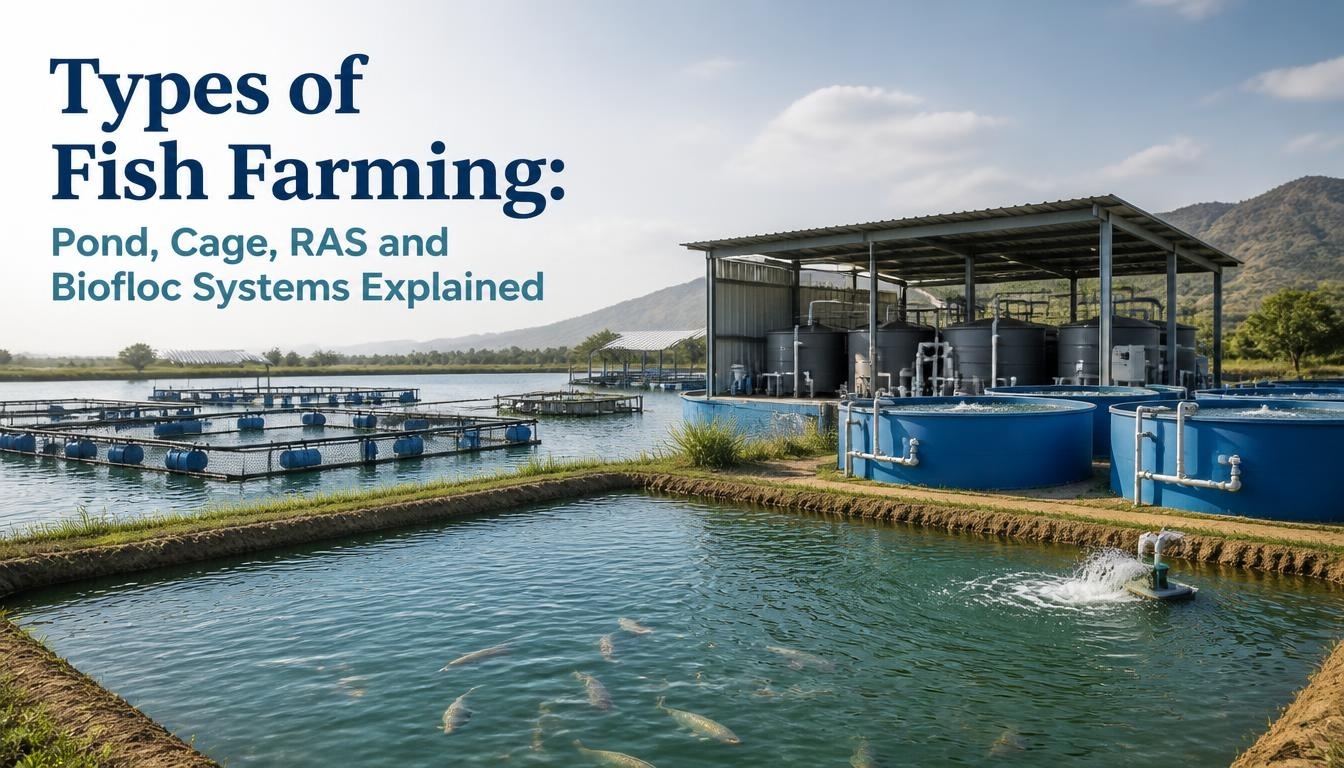
Today, farms supply around half of the fish people eat worldwide, and that share keeps growing. If you are thinking about getting into the business, the first big decision is which of the types of fish farming to choose. Every fish farming system trades off cost, control, and complexity. A simple earthen pond is cheap to start but depends on land, water, and weather. A recirculating system gives you tight control but needs power, skill, and a bigger budget.
This guide walks through the four main types of fish farming (pond, cage, RAS, and biofloc), compares them side by side, and helps you pick a fit for your situation. We pay special attention to freshwater fish farming and to conditions in Pakistan.
Types of Fish Farming at a Glance
Fish farming is the part of aquaculture that raises fish under managed conditions, instead of catching them wild. If you want the wider picture of how these operations run day to day, see our explainer on how fish farms actually operate. For a broader look at species and basic practices across the industry, read our guide to aquaculture farming species, systems, and basic practices.
Broadly, the types of aquaculture split by water (freshwater, brackish, or marine) and by the system used to hold the fish. The different types of fish farming most producers choose between are:
System | Setup cost | Technical skill | Water use | Best for |
Pond | Low to moderate | Low | High, needs a steady source | Beginners with land; carp and tilapia |
Cage | Moderate | Moderate | Uses an existing water body | Lakes, reservoirs, and large rivers |
RAS | High | High | Very low | Controlled, year round, high value production |
Biofloc | Moderate | Moderate to high | Low | Tilapia and small footprint farms |
Other setups exist too, such as raceways (flow through channels), pen culture, and aquaponics, but these four cover most of what new farmers consider. Fish farming is also different from capture fishing, and you can read more about that split in our guide to the types of fisheries.
Pond Fish Farming
Pond culture is the oldest and most widely used fish farming system. Fish are raised in earthen or lined ponds that are filled from a canal, tubewell, river, or rainfall. The pond acts as both the tank and the water treatment plant: natural food, algae, and bacteria all help keep the water usable.
Advantages
• Lowest technical barrier of the four systems
• Lower setup and running costs, especially where land is available
• Works well for polyculture, such as raising several carp species together
• Natural food in the pond can reduce feed costs
Challenges
• Needs land and a dependable water supply
• Production is exposed to weather, temperature swings, and low oxygen
• Lower stocking density than intensive systems
• Disease can spread quickly if water quality slips, so it helps to understand fish diseases, prevention, and seasonal care before you stock
Cage Fish Farming
In cage culture, fish are held in floating net enclosures placed in a lake, reservoir, river, or the sea. The cages are anchored in place, and natural water flow brings in oxygen and carries waste away. This makes cage farming a good way to use water bodies that already exist, without digging ponds.
Advantages
• No land needed beyond the shore or launch point
• Natural water exchange supplies oxygen
• Easy to observe, feed, and harvest the fish
• Can be scaled by adding more cages
Challenges
• Requires a suitable, permitted water body
• Escapes from damaged nets can harm local ecosystems
• Fish are exposed to pollution, storms, and disease in open water
• Heavy feeding can degrade the surrounding water if the site is poorly managed
Cage systems work best where water is deep, clean, and moving, and where local rules allow them.
Recirculating Aquaculture Systems (RAS)
A recirculating aquaculture system, or RAS, is an indoor or covered tank system that cleans and reuses its water. Water leaves the fish tank, passes through a mechanical filter that removes solids, then through a biofilter where beneficial bacteria turn toxic ammonia into much less harmful nitrate. It is then oxygenated and sent back to the fish. Many systems also add UV treatment and degassing.
Advantages
• Uses very little water compared with ponds
• Allows precise control of temperature, oxygen, and water quality
• Supports year round production and high stocking density
• Can be built almost anywhere, even where land and water are limited
Challenges
• High setup cost
• Depends on constant electricity and backup power
• Needs strong technical skill; a pump failure or filter crash can lose a whole crop quickly
• Higher running costs, so it usually pays off only with high value fish or strong markets
Biofloc Fish Farming
Biofloc is a method that uses the water itself as a living filter. Beneficial bacteria and other microbes grow as small clumps called flocs. They consume fish waste and leftover feed, which keeps ammonia under control, and the fish can graze on the flocs as an extra source of protein. Farmers add a carbon source and run strong aeration to keep the microbes healthy and suspended.
Advantages
• Low water exchange, which suits places where water is scarce
• Fits a small footprint, so it works for tanks as well as lined ponds
• Can lower feed costs because the fish eat some of the floc
• Works well for hardy species such as tilapia
Challenges
• Needs constant aeration, so power cuts are a serious risk
• Requires regular testing of ammonia, nitrite, pH, and floc levels
• Has a learning curve: poor management leads to crashes
• Not every species handles the cloudy, microbe rich water well
How to Choose the Right Fish Farming System
There is no single best fish farming system. The right choice depends on your resources and goals. Ask yourself:
• Land and water: Do you have land and a steady water source, or only a lake or a small plot?
• Budget: How much can you invest up front, and how long can you wait for returns?
• Power: Is your electricity reliable enough for RAS or biofloc, or do you have a generator?
• Skill: Do you have experience with water chemistry, or are you learning as you go?
• Species and market: Which fish sell well near you, and which system suits them?
• Rules: Do local fisheries authorities require licences or permission for your site?
If you have land and water, a pond is usually the sensible starting point. If you only have limited space but reliable power and some technical skill, biofloc or RAS may fit better. If a suitable lake or reservoir is available and permitted, cages are worth a look.
In Pakistan, freshwater fish farming is dominated by pond culture. Commonly farmed species include rohu, catla, and mrigal, usually raised alongside silver carp, grass carp, and common carp, while tilapia and pangasius are also farmed. In the cold waters of the northern areas, trout is a popular choice. Whatever you pick, start small, learn how your water behaves, and scale up only after a few successful cycles.
Ready to move from planning to action? Our step by step guide on how to start fish farming covers the practical first steps, and if you want to treat it as a real venture, read how to start an aquaculture farming business for a realistic beginner plan.
Frequently Asked Questions About Types of Fish Farming
What are the main types of fish farming?
The four main types of fish farming are pond culture, cage culture, recirculating aquaculture systems (RAS), and biofloc systems. Pond culture raises fish in earthen or lined ponds, cage culture holds fish in net enclosures in open water, RAS filters and reuses water in tanks, and biofloc uses beneficial microbes to clean water inside tanks or ponds. Other setups such as raceways and aquaponics also exist.
Which fish farming system is best for beginners?
For most beginners with access to land and a reliable water source, a small earthen pond stocked with hardy species such as tilapia or carp is the simplest and cheapest place to start. Ponds are forgiving and need little equipment. RAS and biofloc give more control but require electricity, aeration, and close water quality monitoring, so they suit people who already have some experience.
What is the difference between aquaculture and fish farming?
Aquaculture is the broad term for farming aquatic life, including fish, shrimp, shellfish, and seaweed. Fish farming is the part of aquaculture that focuses specifically on raising fish. So all fish farming is aquaculture, but not all aquaculture is fish farming.
What is a recirculating aquaculture system (RAS)?
A recirculating aquaculture system, or RAS, is a land based setup where fish live in tanks and the water is continuously cleaned and reused. Mechanical filters remove solids, a biofilter converts toxic ammonia into less harmful nitrate, and pumps and oxygen keep conditions stable. It uses very little water and allows year round production, but it costs more to build and depends on constant power.
What is biofloc fish farming?
Biofloc fish farming is a method where beneficial bacteria and other microbes grow in the water as clumps called flocs. These microbes consume fish waste and uneaten feed, which helps control ammonia, and the fish can also eat some of the flocs as extra protein. It needs strong aeration, a carbon source, and regular monitoring, and it works well for hardy species such as tilapia.
Can you do freshwater fish farming at home?
Yes, small scale freshwater fish farming at home is possible using a backyard pond, concrete or plastic tanks, or a small biofloc tank. Start with a hardy species such as tilapia, make sure you have clean water and aeration, and keep the numbers low at first. Check local fisheries rules and whether you need any permission before you begin.
Which fish are best for farming in Pakistan?
Commonly farmed freshwater fish in Pakistan include rohu, catla, and mrigal, along with silver carp, grass carp, and common carp, often raised together in ponds. Tilapia and pangasius are also farmed, and rainbow trout suits the cold waters of northern areas. The best choice depends on your water temperature, system, and local market demand.
Conclusion: Pick the System That Fits Your Situation
The types of fish farming each have a place. Ponds are the accessible, low tech choice, cages make use of open water, RAS delivers control at a high price, and biofloc offers a water saving middle path that rewards careful management. Match the system to your land, budget, power, and skill, and begin on a small scale.
Next step: explore more guides on Breeze Fish Point, starting with how to start fish farming, and build your plan one stage at a time.