
Fish Farms Explained: How They Actually Operate
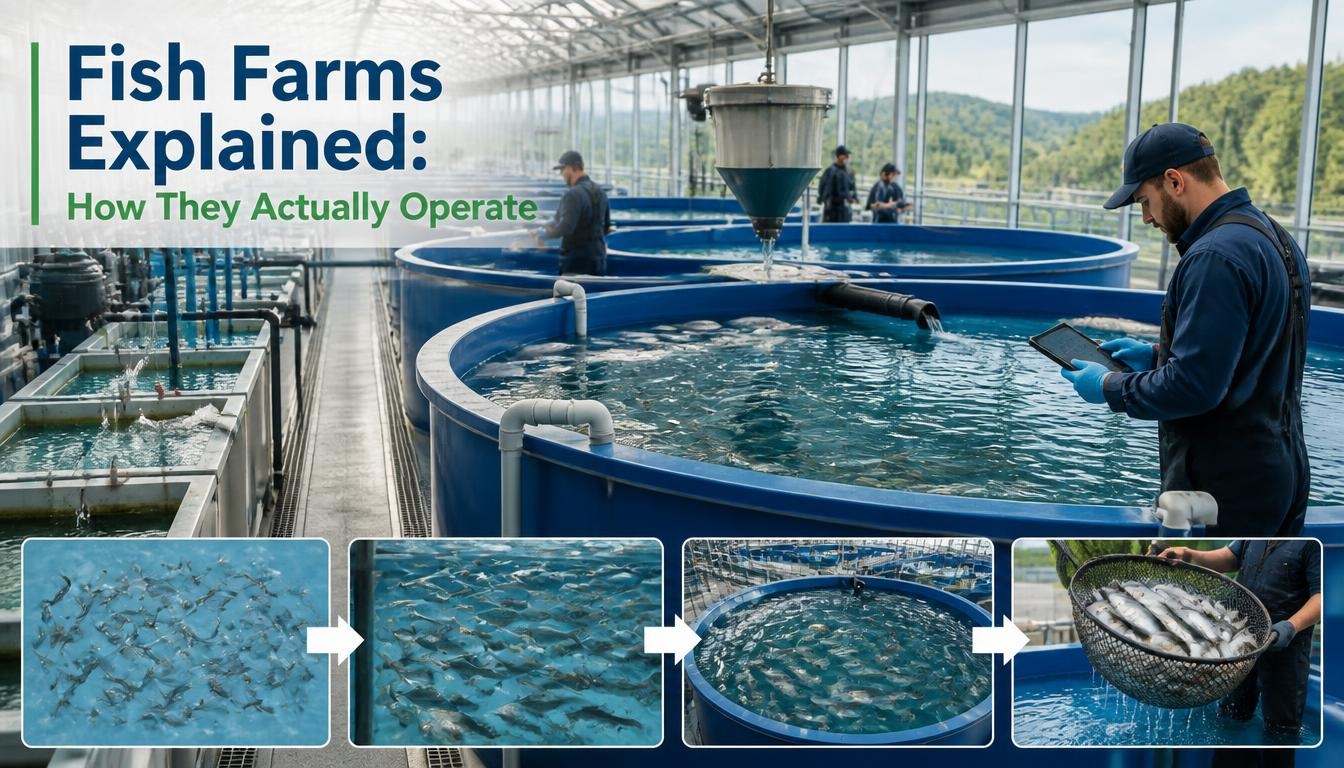
Over half the seafood on plates around the world today started life on a fish farm rather than in open water. So what does that actually look like day to day? A fish farm is a dedicated facility for raising fish in a controlled setting from their earliest juvenile stage all the way to harvest rather than pulling them from rivers, lakes, or the sea. Below is a look at what a fish farm really is, the main setups in use, and a walk through exactly how one runs from stocking to sale.
What Counts as a Fish Farm?
A fish farm is any operation built around raising fish in a managed environment pond, tank, cage, or a fully enclosed system for food, restocking, or commercial sale, rather than depending on wild catch. It's the physical location where aquaculture actually happens, and the scale varies enormously, from a single household pond to industrial operations turning out thousands of tonnes annually.
This industry has expanded fast: farmed fish now account for roughly half of the seafood people eat worldwide, a figure that's climbed for decades as pressure on wild stocks has grown alongside rising global appetite for seafood.
The Common Types of Fish Farms
Most fish farms fall into one of four setups, each with its own fit depending on location, budget, and species:
- Pond farms the most widespread option globally, using earthen or lined ponds that combine natural food like plankton with commercial feed.
- Cage farms netted enclosures set up inside existing lakes, rivers, or coastal waters, so fish grow in a natural body of water while staying contained.
- Recirculating Aquaculture Systems (RAS) indoor tanks where water is filtered and reused on a loop, allowing dense stocking even without a natural water source nearby.
- Biofloc systems tank based farming that relies on bacteria to turn fish waste into extra feed, reducing how often water needs to be changed.
Costs, species fit, and day to day management differ across all four our Cultivation of Fish beginner's guide breaks down site selection, stocking, and startup costs in more depth if you're planning to build one.
How a Fish Farm Runs, Start to Finish
No matter the size or system, nearly every fish farm follows the same general sequence:
1. Stocking. Young fish fry (just hatched) or fingerlings (a bit older) are brought in, almost always from a hatchery rather than bred on site.
2. Feeding. Fish get a diet matched to their species and growth stage, usually blending natural food sources with commercial pellets, fed on a schedule designed to maximize growth and limit waste.
3. Monitoring water and health. Operators check water quality oxygen, pH, ammonia regularly and watch for early signs of disease, since these conditions directly shape how fast and how well fish grow.
4. Tracking growth. Periodic sampling and weighing shows whether fish are on pace, with density and feeding adjusted along the way. Most species hit market size somewhere between 6 and 12 months.
5. Harvest. Once fish hit target weight, they're harvested by draining or netting ponds, or pulling stock from cages or tanks, usually timed around market demand or seasonal patterns.
6. Processing and distribution. From there, fish are cleaned, filleted, or packaged and sent into the supply chain local markets, wholesalers, or export buyers, depending on the farm's scale.
How Fish Farms Stack Up Against Wild Fishing
Fish Farms | Wild Fishing | |
Environment | Fully managed | Natural, uncontrolled |
Supply predictability | High scheduled harvests | Variable stock, weather, rules |
Environmental impact | Localized (water/waste); debated | Risk of depleting wild stocks |
Cost structure | Ongoing feed and infrastructure | Fuel, labor, quota limits |
Each approach brings its own trade offs. Farms give operators a level of predictability wild fisheries simply can't match a farm operator has a rough idea of what and when they'll harvest, something no wild fishery can promise. Northern cod is a good example of the opposite extreme: a wild stock whose numbers rose and crashed almost entirely outside anyone's control, with no way to simply top the population back up once it collapsed. That said, fish farming has its own environmental questions to answer water consumption, waste output, and the risk of disease passing between farmed and wild fish are all still being actively studied and regulated.
Why It Matters and Where the Fish End Up
Fish farms have become essential precisely because wild fisheries alone can no longer meet global seafood demand. Farmed fish now play a real role in food security across many countries, feeding into everything from neighborhood markets to major export pipelines.
After harvest, farmed fish generally follows one of a few routes: sold fresh through local markets, sent to processors for packaged or frozen products, or shipped to international buyers where prices tend to run higher. Bigger commercial farms often work under standing contracts with buyers, while smaller operations lean more on direct local sales.
FAQ
In plain terms, what is a fish farm?
It's a site a pond, tank, or cage setup built specifically to raise fish from a young age through to harvest, rather than relying on catching them in the wild.
Where do the fish on a farm come from originally?
Almost always from a hatchery, which supplies fry or fingerlings that the farm then raises rather than breeding fish itself.
Is farmed fish nutritionally worse than wild caught?
Not inherently nutrition depends much more on the specific species and its diet than on whether it came from a farm or the wild.
From stocking to harvest, how long does one cycle take?
Typically 6 to 12 months for most farmed species, though the exact timeline shifts with species and how well the farm manages growing conditions.
How is a hatchery different from a fish farm?
A hatchery focuses on breeding fish and getting them through their earliest life stages, then passes them along, while a fish farm takes over from there and raises them to harvest size.
Are fish farms bad for the environment?
It varies by farm water use, waste handling, and disease management differ a lot between operations, and all three remain active subjects of research and regulatory oversight.