
Types of Fisheries Explained (Plus the Science Behind It)
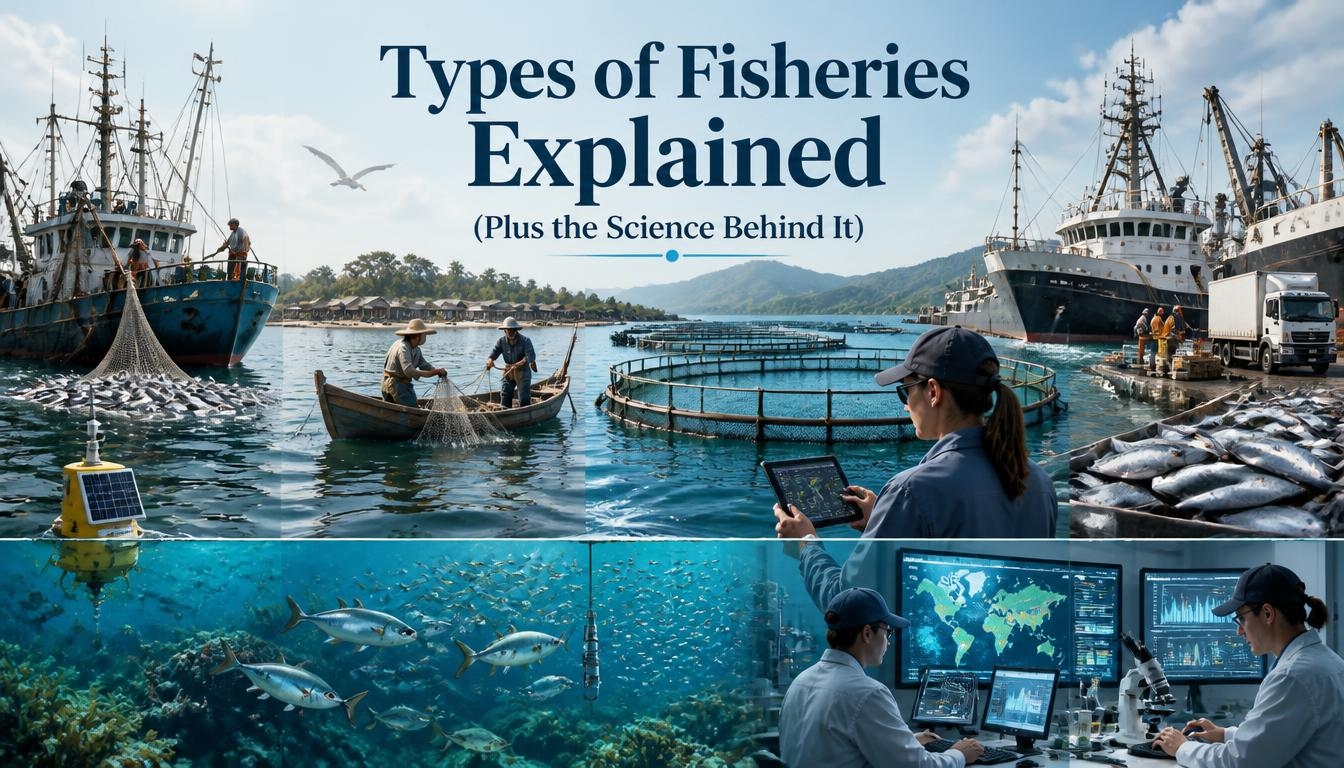
Ask ten people what "fisheries" means and you'll get ten different pictures a fishing boat, a fish farm, a guy with a rod on a lake. All of them are right, technically, because types of fisheries cover an enormous range of activity: wild caught vs. farmed, industrial vs. small scale, for profit vs. for dinner. This guide walks through how fisheries actually get classified, and pulls back the curtain on the fishery science, fisheries data, and fisheries scientist roles that keep all of it running sustainably.
Quick Answer
Fisheries are classified along four main lines: how the seafood is produced (capture vs. aquaculture), how big the operation is (industrial, semi industrial, artisanal), why it's being fished (commercial, recreational, subsistence), and where it happens (marine, freshwater/inland, brackish). Fisheries science ties all of these together by supplying the data used to manage them sustainably.
Capture Fisheries vs. Aquaculture: The Big Split
Every fishery ultimately falls into one of two production categories:
- Capture fisheries harvesting wild fish and seafood straight from their natural habitat: rivers, lakes, estuaries, or the open ocean. This is the classic image of "fishing."
- Aquaculture (culture fisheries) farming fish and shellfish in a controlled setting, whether that's a pond, a tank, or an offshore net pen. Aquaculture has grown so fast that it now supplies roughly half of the world's seafood, edging out wild capture for the first time in recent years.
Types of Fisheries by Scale
- Industrial fisheries large, capital heavy operations with mechanized vessels, sonar, and advanced navigation gear, built to supply national or global markets.
- Semi industrial fisheries a step down in scale and mechanization, sitting between artisanal and full industrial operations.
- Artisanal / small scale fisheries traditional, low tech operations using small boats and short trips close to shore. Depending on the country, "artisanal" might mean a hand line canoe or a 20 meter trawler.
Types of Fisheries by Purpose
- Commercial fisheries fished to sell, whether that's a massive trawler operation or a small artisanal boat supplying a local market.
- Recreational fisheries fished for sport and enjoyment, not profit; a major driver of coastal and lake town tourism economies.
- Subsistence fisheries fished to feed the fisher's own family or community rather than to sell.
Types of Fisheries by Habitat
- Marine fisheries saltwater operations ranging from near shore reefs and mangroves to open ocean and seamount fisheries.
- Inland/freshwater fisheries rivers, lakes, ponds, reservoirs, and wetlands.
- Brackish water fisheries transitional estuary and lagoon environments where fresh and saltwater mix.
What Fisheries Science Actually Looks Like
Here's the part most guides skip: none of these fisheries stay sustainable on their own. That's where fisheries science comes in an interdisciplinary field combining ecology, statistics, and population dynamics to figure out how much can safely be caught, and where.
Fisheries work in this field isn't just lab coats and spreadsheets. A fisheries scientist's day might involve:
- Running field or sea going surveys to count and sample fish populations
- Tagging and tracking fish to study growth, migration, and survival
- Collecting fisheries data on total catch, stock size, and environmental conditions
- Building stock assessment models to estimate sustainable harvest levels
- Advising government agencies, commercial fleets, and conservation groups on management rules
Most fisheries scientists hold a degree in fisheries science, marine biology, or a related field, with advanced roles often requiring a master's or PhD. It's a career that blends outdoor field research with data heavy analytical work genuinely different day to day depending on the season and the project.
Types of Fisheries at a Glance
Classification | Categories | Example |
Production method | Capture / Aquaculture | Wild salmon vs. farmed salmon |
Scale | Industrial / Semi industrial / Artisanal | Factory trawler vs. small skiff |
Purpose | Commercial / Recreational / Subsistence | Export seafood vs. weekend fishing trip |
Habitat | Marine / Inland / Brackish | Open ocean tuna vs. river catfish |
FAQs
What are the 4 main ways fisheries get classified?
By production method (capture vs. aquaculture), scale (industrial, semi industrial, artisanal), purpose (commercial, recreational, subsistence), and habitat (marine, inland/freshwater, brackish).
Is aquaculture bigger than wild caught fishing now?
Yes aquaculture now accounts for roughly half of global seafood production, having overtaken capture fisheries output in recent years according to FAO data.
What does fisheries data actually get used for?
Fisheries data catch totals, stock assessments, tagging results, environmental readings is what fisheries scientists use to figure out sustainable harvest limits and flag when a stock is being overfished.
What kind of work does a fisheries scientist do day to day?
It varies: field surveys and fish sampling, tagging and tracking studies, lab analysis, and building population models, plus advising agencies or fishing industries on management decisions.
What degree do you need to become a fisheries scientist?
Most entry level roles want a bachelor's degree in fisheries science, marine biology, ecology, or a related field, with advanced positions often requiring a master's or PhD.
Bottom Line
Whether it's a subsistence fisher pulling dinner from a river or an industrial fleet supplying international markets, every type of fishery ultimately depends on the same thing: solid fisheries science keeping the numbers honest. Understanding how fisheries data gets collected and what a fisheries scientist actually does with it makes it a lot easier to see why some fisheries stay healthy for generations while others collapse.
For more on how this plays out in practice, check out our Fishing & Seafood Industry hub, or see what a career in the field can look like in our guide to Fisheries Management Salary.