
Northern Cod Guide: Habitat, Numbers & Fishery Story
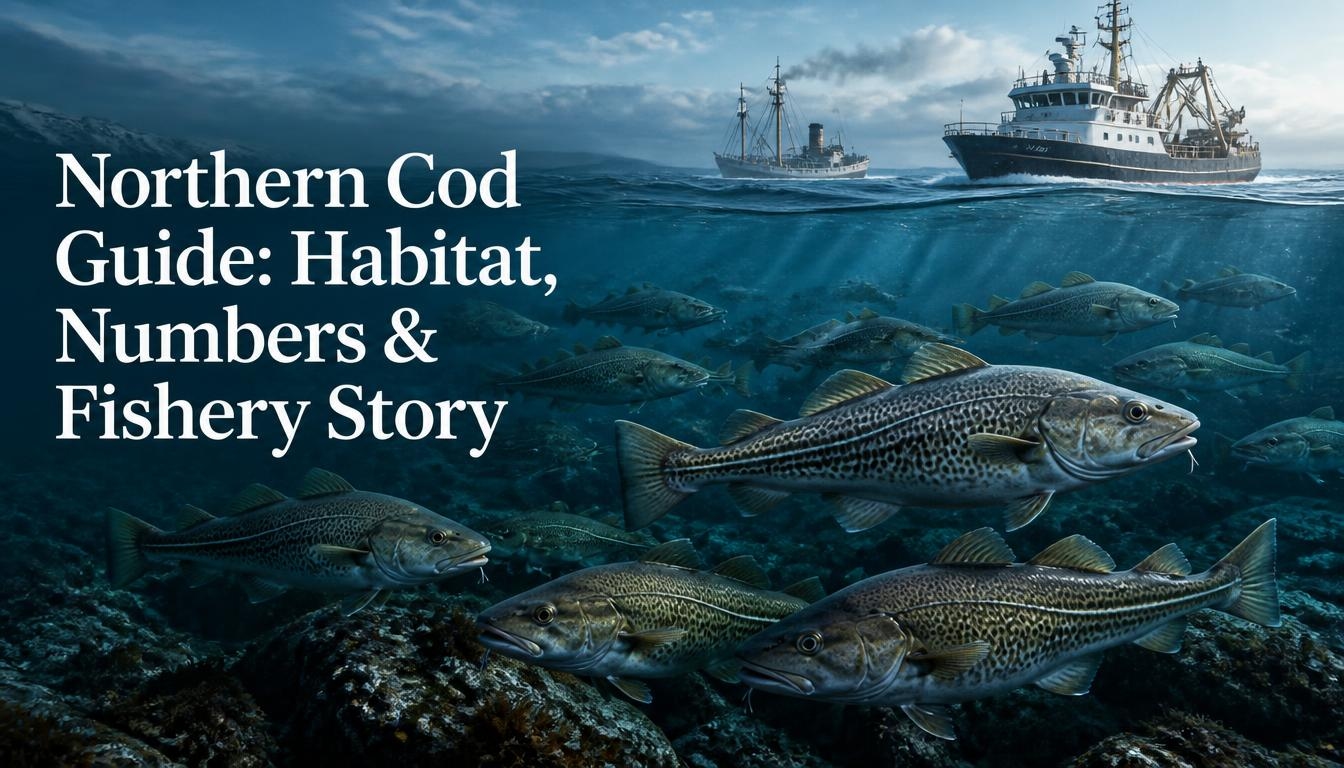
There aren't many fish whose story doubles as a case study in what happens when a fishery is pushed too far. Northern cod is one of them a population that once ran into the millions of tonnes, ranged across some of the coldest, richest fishing grounds in the North Atlantic, and carried a fishing tradition stretching back five centuries, before nearly vanishing overnight. This guide walks through what the stock actually is, where it lives, how its numbers have shifted over time, and the fishing history behind it.
What Exactly Is Northern Cod?
Northern cod isn't a distinct species on its own it's the regional name for the Atlantic cod (Gadus morhua) population found specifically within NAFO (Northwest Atlantic Fisheries Organization) zones 2J3KL, off Newfoundland and Labrador. Several other Atlantic cod stocks exist elsewhere in Canadian and international waters, but this particular population is the one behind the story that follows.
Physically, Northern cod look like any other Atlantic cod: an elongated body, mottled greenish brown coloring on top, a pale underside, and a small barbel under the chin. What set the population apart historically was its age structure older, larger fish made up an outsized share of breeding stock, which turned out to be a critical weak point once fishing pressure zeroed in on those exact fish.
Habitat and Range
This stock is tied to the cold shelf waters running from the Labrador coast down across the Grand Banks a stretch of ocean so productive it pulled fishing fleets from across the Atlantic for hundreds of years. The 2J3KL designation itself breaks down into three zones: 2J (Labrador Shelf), 3K (Northeast Newfoundland Shelf), and 3L (Grand Bank), and all three together define the boundaries used in every official stock assessment.
Cold bottom temperatures and capelin availability drive where Northern cod actually concentrate. Capelin is this stock's main prey, and historically, wherever capelin numbers or water temperature shifted, cod distribution and condition followed a pattern that still shapes where the population is found today.
Five Centuries of Fishing History
Cod fishing on the Grand Banks dates back to the 1500s, when European crews first began working these waters, eventually turning the fishery into the economic backbone of Newfoundland and Labrador for generation after generation. For most of that stretch, catch levels stayed within what the population could replace.
The postwar decades changed everything. Factory trawlers bigger, more efficient, able to fish far deeper and farther than inshore boats moved into the Grand Banks and pushed catches to record highs through the 1960s. In 1962, the spawning biomass was estimated at 1.6 million tonnes. By the 1980s, the total allowable catch had risen to around 240,000 tonnes annually, a harvest rate the population simply couldn't keep pace with for long.
How the Population Collapsed
Year after year of intense fishing from Canadian and foreign fleets alike wore the stock down, even while catch figures held steady or climbed. By the early 1990s, the damage was unmistakable: spawning biomass had fallen roughly 93 percent in three decades, dropping from 1.6 million tonnes in 1962 to somewhere around 72,000 to 110,000 tonnes by 1992.
A handful of compounding factors drove the crash:
• Industrial scale trawling modern factory vessels out fished the traditional inshore fleet by a wide margin, pulling fish out faster than reproduction could offset.
• Loss of prime breeding stock the largest, most reproductively valuable fish were also the ones most targeted, hitting the population where it hurt most.
• Quotas that lagged reality catch limits were consistently set behind where the stock actually stood, and enforcement across international fleets was uneven at best.
• Late scientific recognition by the time the extent of the decline was fully clear, the stock had already crossed into crisis territory.
The 1992 Shutdown and Its Aftermath
Canada announced a full moratorium on commercial Northern cod fishing on July 2, 1992 originally expected to run about two years. It lasted 32.
The fallout was immediate and severe. About 30,000 fishers and plant workers across Newfoundland and Labrador lost their jobs at once roughly 12 percent of the province's entire workforce with the wider ripple effect pushing total job losses closer to 40,000. It's still the single largest mass layoff in Canadian history.
Ottawa rolled out support programs, first NCARP (Northern Cod Adjustment and Recovery Program) and later TAGS (Atlantic Groundfish Strategy), aimed at cushioning displaced workers with financial aid and retraining. Even so, the province's population fell by roughly 10 percent over the following ten years as people left in search of work elsewhere, and many outport communities built around the fishery never fully recovered.
2024: The Fishery Reopens
Thirty two years after the shutdown, Canada lifted the commercial moratorium, allowing directed fishing to resume within the historic range. The reopened quota climbed modestly from 13,000 tonnes in 2023 to 18,000 tonnes in 2024, plus a separate 1,000 tonne allowance for offshore international vessels. Compared to the roughly 240,000 tonnes caught annually before the 1992 collapse, this is a small fraction of the fishery's former scale.
The reopening followed a late 2023 stock reassessment that moved Northern cod out of its most severe risk category. Not everyone welcomed the decision equally seafood producer groups supported it, while several inshore harvester unions argued the stock still hadn't recovered enough to justify resuming commercial fishing.
Where Things Stand Today
Calling the 2024 reopening a full recovery would be overstating it the new quota only allows around 6 percent of the estimated biomass to be harvested, a fraction of the 50 plus percent taken annually in peak pre collapse years.
Risk hasn't disappeared, either. Current projections put the odds of the stock declining again between 2024 and 2027 as high as 62 to 76 percent, meaning a slide back into critical status by 2025 is a real possibility. Add in climate driven shifts in ocean temperature affecting both cod and capelin across the range, and the path forward stays uncertain.
| Pre Collapse (1980s) | 2023 | 2024 (Post Moratorium) |
Total Allowable Catch | ~240,000 tonnes | 13,000 tonnes | 18,000 tonnes |
Share of Biomass Harvested | 50%+ in peak years | N/A (moratorium) | ~6% |
Population Status | Healthy, declining | Critical | Improved, still fragile |
Most fisheries scientists agree the population is still far from where it once stood, and how well the reopened fishery is managed in the coming years will largely determine what happens next.
FAQ
What exactly is Northern cod?
It's not a separate fish species Northern cod is the name given to the Atlantic cod (Gadus morhua) population living in NAFO zones 2J3KL, off Newfoundland and Labrador.
Where can Northern cod be found?
This stock sticks to the cold shelf waters of the Labrador Shelf and Grand Banks, staying close to capelin, its main food source.
What led to the crash in Northern cod numbers?
Heavy trawling by domestic and foreign fleets, combined with the loss of large breeding age fish and slow moving quota rules, pushed the spawning stock down roughly 93 percent from 1962 to 1992.
Is the Northern cod fishing ban still in place?
No Canada ended the 32 year moratorium in 2024, setting a new catch limit of 18,000 tonnes for the reopened commercial fishery.
Have Northern cod numbers bounced back?
Only partially. The stock improved enough to justify a small reopened fishery, but current models still flag a substantial chance of renewed decline.
Is Northern cod a different fish from Atlantic cod?
No Northern cod is simply the regional name for one Atlantic cod stock. Every Northern cod is an Atlantic cod, though most Atlantic cod belong to other stocks entirely.
How badly did the 1992 shutdown hit Newfoundland?
Roughly 30,000 people in fishing and processing lost their jobs at once, making it the largest single layoff event Canada has ever recorded.