
Blue Catfish 101: Identification, Records & Fishing Tips
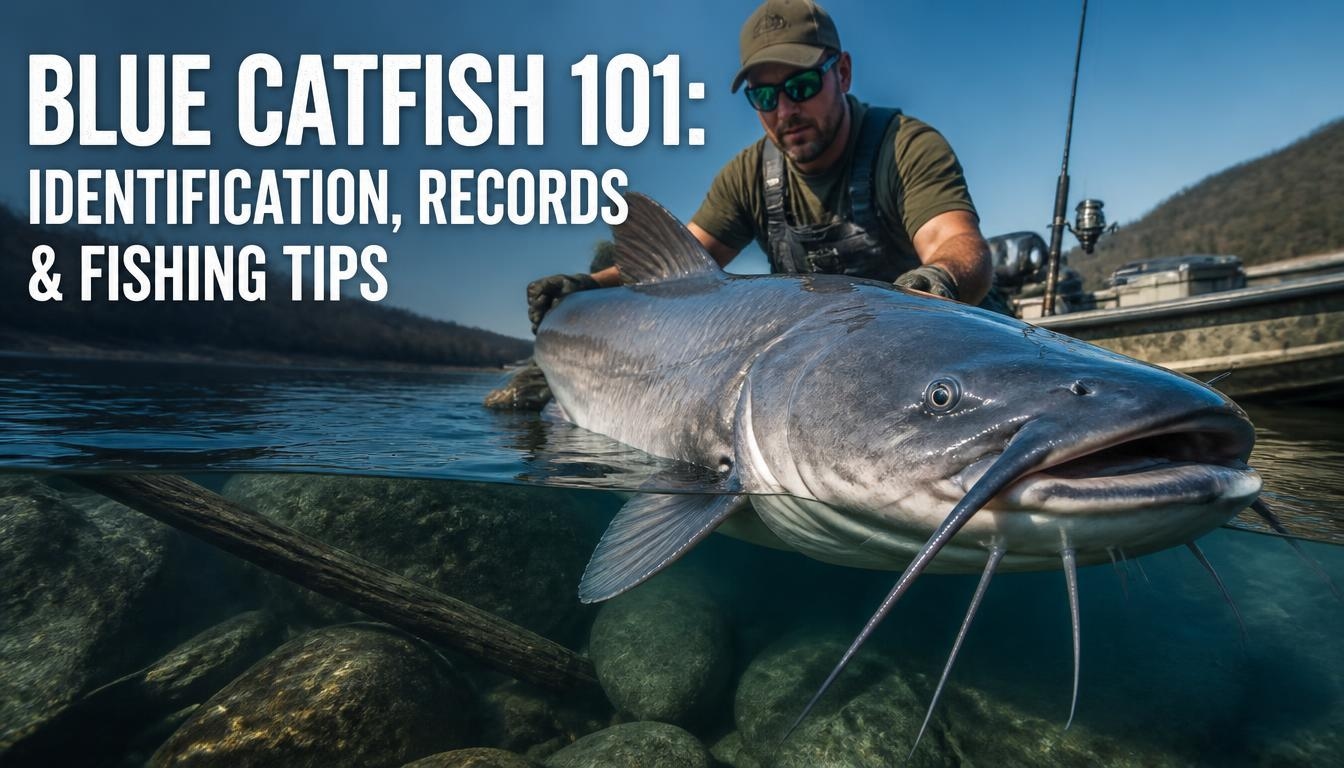
If you've ever hooked something on the bottom of a big river that felt like it was never going to stop pulling, there's a decent chance it was a blue catfish North America's largest catfish species and one of the toughest fights in freshwater fishing. This guide covers what actually works when targeting them, plus the identification details and biology worth knowing before you head out.
Fishing Tips That Actually Work for Blue Catfish
- Bait: Fresh cut bait shad, herring, or skipjack herring outperforms nearly everything else for targeting bigger fish; blue catfish hunt by scent more than sight.
- Where to fish: Target river channels, deep holes, and current breaks near tributary mouths, where baitfish naturally concentrate.
- Gear: Go heavier than you think you need tackle rated for 50+ pounds and strong circle hooks are standard for serious blue catfish anglers, both for landing big fish and for safe catch and release.
- Technique: Drift fishing over likely holding water or anchoring with bottom rigs are the two go to approaches; both put bait directly in the strike zone near the bottom.
- Timing: Warm months tend to produce the most consistent bite, though blue catfish stay catchable through most of the year in many river systems.
How to Identify a Blue Catfish
Blue catfish have a slate blue to silvery body, a white belly, smooth scaleless skin, a deeply forked tail, and four pairs of black barbels around the mouth. The detail that actually settles arguments at the dock is the anal fin: blue catfish carry a straighter edged anal fin with 30 to 36 rays, while channel catfish their closest lookalike have a shorter, more rounded anal fin with only 24 to 29 rays and typically show dark spots that blue catfish don't have.
Size and Records
Metric | Figure |
Typical adult length | Under 2 feet |
Maximum length | Roughly 5 feet (165 cm) |
Maximum weight | Over 100 lbs (up to ~150 lbs per FishBase) |
IGFA all tackle world record | 143 lbs, Buggs Island Lake (Kerr Lake), VA/NC border, 2011 |
Typical lifespan | 9–10 years |
Maximum recorded lifespan | Up to 25 years |
That world record 143 pound fish is one of the largest freshwater catches ever documented on rod and reel in North America a size range that's realistically only possible for the largest, oldest individuals.
Where Blue Catfish Live: Native vs. Introduced Range
Blue catfish are native to the Mississippi, Missouri, and Ohio River basins, along with the Rio Grande basin. In the 1970s and 1980s, they were deliberately introduced into the James, York, and Rappahannock rivers feeding the Chesapeake Bay to build a trophy recreational fishery. It worked arguably too well. Blue catfish tolerate brackish water and move freely between rivers and the bay itself, and their population has since grown large enough that the species is now considered one of the Chesapeake Bay's most significant invasive threats, preying on native shad, herring, blue crab, and even juvenile Atlantic sturgeon.
What Blue Catfish Eat
Research on Chesapeake Bay populations found blue catfish to be generalist omnivores with one of the broadest diet ranges ever recorded in an estuarine fish they'll eat fish, crustaceans, and mollusks opportunistically, which is a major reason they've been able to establish such dense populations outside their native range.
Is Blue Catfish Good Table Fare?
Yes, and increasingly it's being promoted as such. A Maryland DNR study of Chesapeake Bay blue catfish found mercury levels under 0.47 ppm and PCB levels between 0.001 and 0.856 ppm in fish up to 41 inches both well under FDA/EPA safety thresholds of 1.0 ppm and 2.0 ppm respectively. Regional agencies actively encourage eating invasive blue catfish as one tool for controlling the population, so keeping a legal sized fish for the table isn't just fine, it's arguably helpful.
FAQs
What's the best bait for blue catfish?
Fresh cut bait especially shad, herring, or skipjack herring is the most consistently effective choice, since blue catfish locate food primarily by scent.
How can you tell a blue catfish from a channel catfish?
Check the anal fin: blue catfish have a straighter edge with 30–36 rays, while channel catfish have a shorter, more rounded anal fin with 24–29 rays and often visible dark spots.
What's the biggest blue catfish ever caught?
The IGFA all tackle world record is 143 pounds, caught in 2011 at Buggs Island Lake (Kerr Lake) on the Virginia–North Carolina border.
Are blue catfish invasive everywhere?
No they're native to the Mississippi, Missouri, Ohio, and Rio Grande basins, but they're considered invasive in the Chesapeake Bay watershed after being intentionally introduced there in the 1970s and 1980s.
What gear do you need to target big blue catfish?
Heavy tackle rated for 50+ pounds and strong circle hooks are standard, since blue catfish can exceed 100 pounds and put up a serious fight.
Can you eat invasive blue catfish safely?
Yes testing has shown mercury and PCB levels in Chesapeake Bay blue catfish up to 41 inches stay well under FDA and EPA safety limits, and eating them is actively encouraged as a population control measure.
Conclusion
Blue catfish reward anglers who fish deliberately fresh cut bait, heavy tackle, and patience near river channels and current breaks and they're worth understanding on both sides of their range: a legitimate trophy species in the Mississippi, Missouri, and Ohio basins, and an invasive problem worth targeting hard in places like the Chesapeake Bay. Either way, the anal fin is your fastest way to confirm exactly what's on the other end of the line.
Looking for more species to target? Check out our guide to lake fish species every angler should know, or see our ranked list of best freshwater fish for eating if you're planning to keep your catch.