

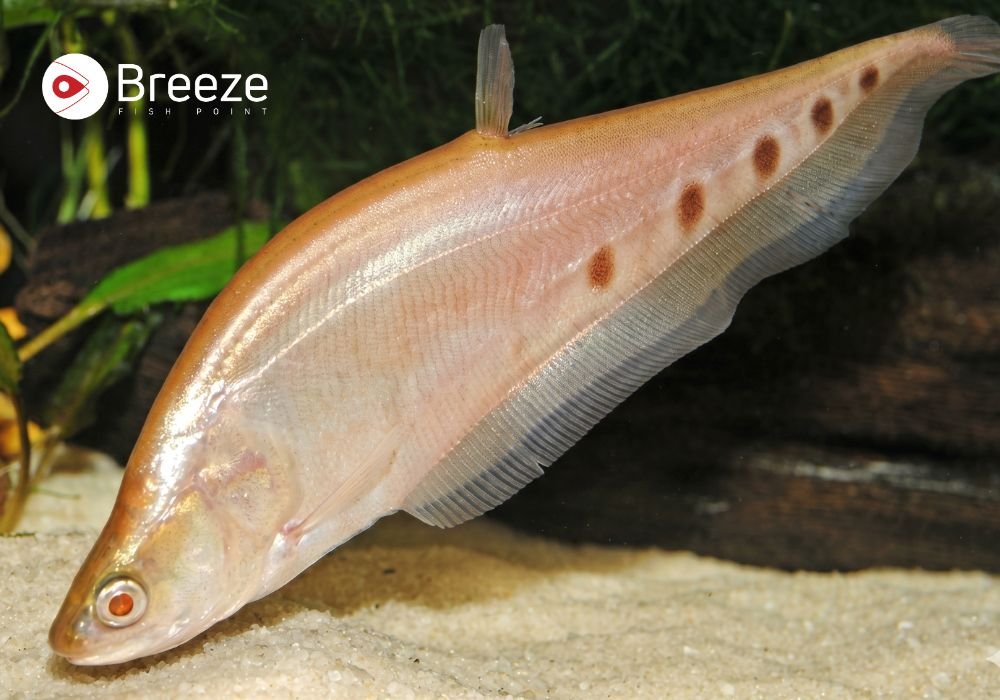
There’s something almost magical about watching a knife fish move through the water. Instead of swimming like most aquarium fish, it glides in a smooth wave-like motion that makes it look mysterious and elegant.
That unique movement is exactly why so many fish lovers are drawn to species like the black ghost knifefish, clown featherback, and the impressive royal clown knifefish.
If you’re thinking about buying one, this guide will help you understand the temperament of popular species like Chitala ornata, Apteronotus albifrons, the spotted knifefish, and other fascinating knifefish.
Understanding Knife Fish Temperament
Most knifefish are naturally nocturnal predators, which means they become more active after the lights go out. During the day, they usually hide in caves, driftwood, or plants. At night, they explore the tank and search for food.
Because of this nighttime behavior, many owners think their fish is suddenly becoming aggressive, when in reality it is simply following its hunting instincts.
Knifefish are usually aggressive in three situations:
- When the tank is too small
- When smaller fish are kept with them
- When another knifefish shares the same hiding area
So rather than being “mean,” they are simply territorial and predatory by nature.
How Aggressive Are Clown Knife Fish?
The clown featherback, also known as the royal clown knifefish, is one of the larger and more powerful knifefish species in the hobby.
Scientifically known as Chitala ornata, this species starts out as a beautiful juvenile with eye-catching spots, but it quickly grows into a large predator. As adults, they can become highly territorial and will eat almost any fish small enough to fit in their mouthS.
This is why clown knives are often considered semi-aggressive to aggressive, especially in community tanks.
If you keep a Chitala ornata in a spacious tank with large companions, it can behave calmly. But in smaller setups, it may chase, stress, or eat tank mates.
A good rule is simple:
If another fish can fit in its mouth, it is not a safe tank mate.
Is the Black Ghost Knife Fish Aggressive?
The black ghost knife fish is often much calmer than a clown knife, which is why it is one of the most loved knife fish in home aquariums.
Known by its scientific name Apteronotus albifrons, this species is shy, intelligent, and usually peaceful with medium to large tank mates. It spends most of the day hiding and becomes active in dim light.
Still, the black ghost knife fish can show aggression when:
- The tank is overcrowded
- Another knife fish is added
- It feels unsafe
- There are not enough hiding caves
- Small fish are swimming nearby
Its peaceful nature depends heavily on the setup. In the right environment, Apteronotus albifrons can be a gentle centerpiece fish.
Is Black Ghost Knife Fish Rare?
A lot of hobbyists ask whether the black ghost knife fish is rare.
The good news is that it is not rare in the aquarium trade. In fact, it’s one of the easiest knife fish to find in fish stores because of its striking black body and ribbon-like swimming style.
What can be difficult to find is a healthy specimen.
A healthy fish should:
- Have a full body
- Swim smoothly
- Show clear white markings on the tail
- Respond well during feeding
- Avoid crashing into decorations
So while it isn’t rare, choosing the right one makes all the difference.
What About the Spotted Knifefish?
The spotted knifefish is another species that fish keepers admire for its unusual markings and calm daytime behavior.
In terms of temperament, it usually sits in the middle. It is less intense than the clown featherback but can still become territorial in tight spaces.
Like most knife fish, it prefers:
- Dim lighting
- Hiding caves
- Slow tank mates
- Plenty of swimming room
With the right setup, the spotted knifefish can live peacefully for years.
Why Knife Fish Sometimes Become Aggressive
Many aggression problems happen because owners underestimate how specialized these fish are.
Here are the most common reasons:
1) Small tank size
Large species like the royal clown knife fish need a huge tank to feel secure.
2) Wrong tank mates
Tiny schooling fish may simply be seen as food.
3) Lack of hiding places
Without caves or driftwood, knife fish stay stressed and defensive.
4) Multiple knife fish together
Many knifefish species dislike sharing territory with similar fish.
5) Poor feeding routine
Hungry fish are naturally more aggressive during nighttime activity.
Most of the time, fixing the environment solves the problem.
What Is the Most Invasive Fish in the USA?
When people ask this question, species like Asian carp and lionfish usually come to mind first.
However, the clown featherback (Chitala ornata) has also become an invasive concern in places like Florida. Because it grows large, hunts efficiently, and adapts well, it can survive outside aquariums if released.
This is why responsible fishkeeping matters so much.
Never release unwanted knife fish into lakes, ponds, or rivers.
Best Tank Mates for Knife Fish
The best tank mates are fish that are:
- Too large to be eaten
- Calm but confident
- Comfortable in dim tanks
- Not aggressive fin nippers
Great choices include:
- Silver dollars
- Larger gouramis
- Peaceful cichlids
- Severums
- Synodontis catfish
- Large plecos
Avoid:
- Guppies
- Tetras
- Shrimp
- Tiny rasboras
- Other knife fish
This simple choice can make a huge difference in aggression levels.
Should You Buy a Knife Fish?
A knife fish can be one of the most rewarding fish you’ll ever own, but only if you understand what it needs.
It’s a great choice if you:
- Have a large tank
- Love unique nocturnal fish
- Can provide caves and driftwood
- Understand predator behavior
- Want a true centerpiece species
It may not be the best choice if you are building a peaceful nano community.
FAQS
How aggressive are clown knife fish?
Is the black ghost knife fish rare?
No, it is common in aquarium stores.
Healthy and well-fed ones are simply harder to find.
What is the most invasive fish in the USA?
Asian carp and lionfish are the most well-known invasive fish.
Clown knifefish are also invasive in some Florida waters.
Can black ghost knife fish live with other fish?
Yes, they do well with medium to large peaceful fish.
Avoid keeping them with tiny fish or other knifefish.
How big does Chitala ornata get?
It can grow over 3 feet long in the right conditions.
That makes it a fish for very large aquariums only.
Final Thoughts
Their aggression toward knife fish usually comes from hunting instincts, territorial behavior, or poor tank setups.
The black ghost knife fish (Apteronotus albifrons) is usually calmer and more beginner-friendly for larger tanks, while the clown featherback (Chitala ornata) and royal clown knife fish are much more predatory.
If you give them enough room, proper hiding spots, and suitable tank mates, these fish become fascinating, graceful, and unforgettable pets.