
Top Fisheries Management Degree Programs to Consider in 2026
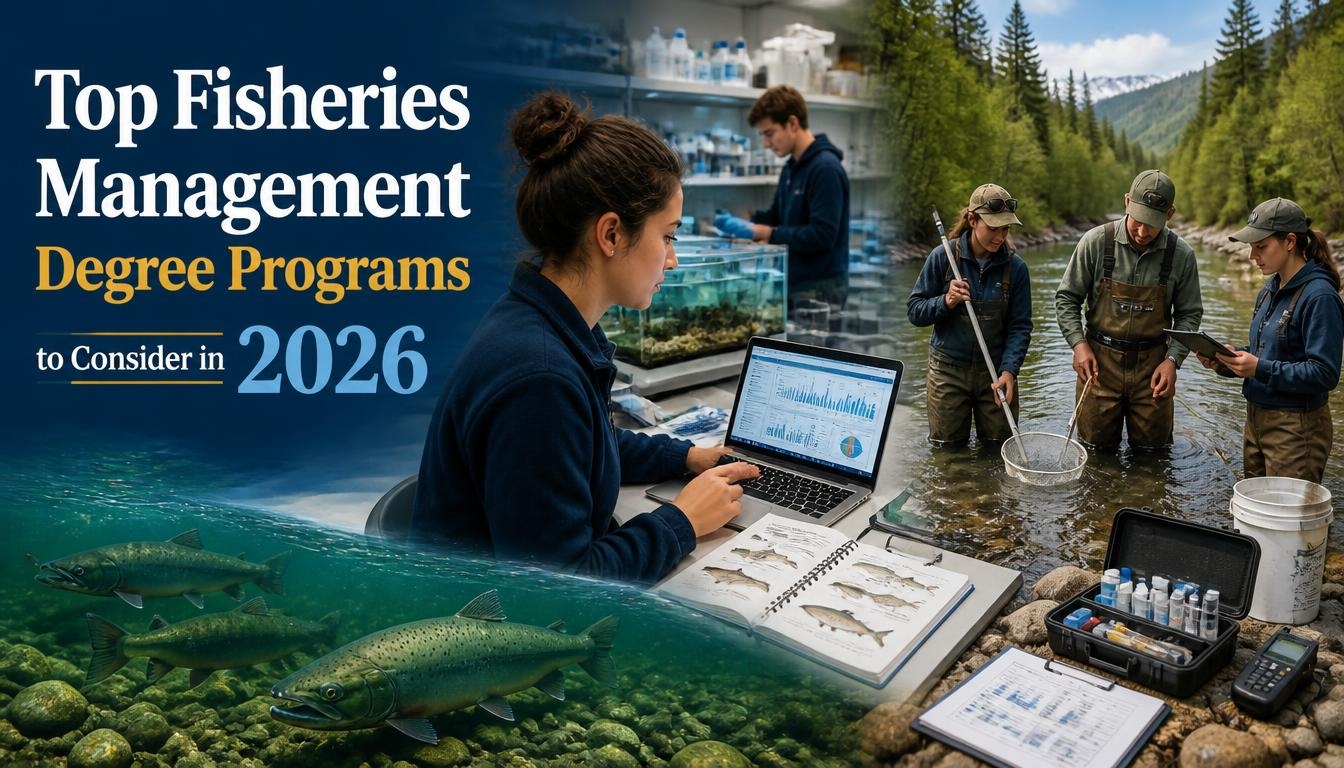
A fisheries management degree opens the door to work most people never see: counting spawning salmon on a river survey, managing a state hatchery, or running population models that decide next season's catch limits. But not every fisheries biologist degree program gives students the same access to that kind of fieldwork. This guide walks through the standout undergraduate and graduate programs, the realistic online options, and what a fisheries biologist degree actually pays once you're working in the field.
What Does a Fisheries Management Degree Actually Cover?
Programs in this space usually sit inside a department of fisheries, wildlife, and conservation biology, since managing fish populations is inseparable from managing the habitats and ecosystems around them. Expect a curriculum built around fish population dynamics, aquatic ecology, water quality science, statistics, and natural resource policy, with fieldwork electrofishing surveys, hatchery rotations, stream assessments layered on top of the classroom work.
Strongest Undergraduate Programs
School | What Sets It Apart |
Virginia Tech (Virginia Polytechnic Institute and State University) | Top ranked nationally for fishing & fisheries sciences & management, based in Blacksburg, VA. |
Texas A&M University | Large fisheries and wildlife sciences department with extensive hands on field opportunities. |
Oregon State University | Department of Fisheries, Wildlife, and Conservation Sciences spanning undergrad through PhD. |
Michigan State University | Dedicated Department of Fisheries and Wildlife with an applied research focus. |
University of Florida | Multiple wildlife, fish, and wildlands science degree tracks backed by strong research funding. |
University of Wisconsin Stevens Point | Wildlife Ecology and Management major that students can tailor toward fisheries work. |
Auburn University | Long established fisheries program with strong ties to aquaculture research. |
UC Davis | Wildlife, Fish and Conservation Biology major with a broad ecology and evolution base. |
Best Graduate Programs for a Fisheries Career
For students planning to move into research, senior agency roles, or academia, fisheries graduate programs at these schools consistently draw strong reviews and active research funding:
- Clemson University active fisheries and wildlife research groups with positive graduate student reviews.
- University of Wisconsin Madison long established natural resources graduate school with fisheries specializations.
- Brigham Young University graduate wildlife and fisheries management tracks with close faculty mentorship.
- University of Washington a strong pick for students focused on Pacific and marine adjacent fisheries research.
- Texas A&M University offers both master's and doctoral tracks in fisheries and wildlife sciences.
- University of Florida deep graduate research infrastructure supporting advanced fisheries work.
Can You Get a Fisheries or Aquaculture Degree Online?
Fully remote options are limited by how field heavy this discipline is, but a handful of programs offer a genuine aquaculture degree online path:
- Unity Environmental University's BS in Marine Biology and Sustainable Aquaculture is a fully online, 120 credit program built for working adults, with up to eight start dates a year.
- Colorado State University's Department of Fish, Wildlife, and Conservation Biology offers both on campus and online program formats.
- Southern New Hampshire University's BS in Environmental Science with a Natural Resources & Conservation concentration works as an online friendly entry point into fisheries adjacent careers.
Before enrolling in an online track, ask directly how the program handles required field practicums a fisheries wildlife and conservation biology degree is only as strong as the hands on experience behind it.
What a Fisheries Biologist Degree Actually Pays
Career Stage | Typical Salary Range |
Entry level (research technician, field biologist) | $35,000 $50,000 |
Mid career (fisheries scientist, environmental consultant) | $55,000 $80,000 |
National median (zoologists & wildlife biologists, BLS 2024) | $72,860 |
Bottom 10% | Under $48,240 |
Top 10% (senior research, federal roles) | Over $113,350 |
Geography matters too: coastal states with active fisheries industries and federal research facilities tend to pay more than landlocked regions, and a master's degree typically pushes earnings toward the upper half of this range.
How to Compare Programs Before You Apply
- Field access: prioritize schools with hatcheries, field stations, or state agency partnerships built into the curriculum.
- Faculty specialty: match program strengths (freshwater, marine, aquaculture) to the career direction you actually want.
- Outcomes data: ask for recent graduate employment rates and where alumni ended up working.
- Cost structure: in state public tuition is usually the biggest lever for keeping total cost down.
- Online fit: confirm whether an online track meets the fieldwork requirements for the jobs you're targeting.
FAQs
What degree is required to work as a fisheries biologist?
A bachelor's degree in fisheries science, wildlife biology, or a related field is the standard entry point, while research focused and senior agency roles usually require a master's degree or PhD.
Which schools have the best fisheries management degree programs?
Virginia Tech, Texas A&M, Oregon State University, Michigan State University, and University of Florida are among the most consistently recommended schools for fisheries and wildlife management degrees.
Is there such a thing as an aquaculture degree online?
Yes Unity Environmental University offers a fully online BS in Marine Biology and Sustainable Aquaculture, and Colorado State University offers an online path through its Department of Fish, Wildlife, and Conservation Biology.
What salary can you expect with a fisheries biologist degree?
The BLS reports a 2024 median annual wage of $72,860 for zoologists and wildlife biologists, with entry level roles starting around $35,000 $50,000 and senior positions exceeding $113,350.
Do fisheries graduate programs require a specific undergraduate major?
Most fisheries graduate programs prefer applicants with an undergraduate background in biology, wildlife science, or fisheries science, though related environmental science majors are often considered with relevant coursework or research experience.
What's the difference between fisheries science and fisheries wildlife and conservation biology degrees?
Fisheries science programs tend to emphasize aquaculture, hatchery management, and applied fish production, while fisheries, wildlife, and conservation biology degrees take a broader ecosystem management approach that includes habitat and wildlife alongside fish populations.
Conclusion
The right fisheries management degree comes down to fieldwork access and faculty fit more than name recognition. Schools like Virginia Tech, Texas A&M, and Oregon State University offer deep hands on infrastructure for students who can attend in person, while programs like Unity Environmental University's online aquaculture degree fill a real gap for students who need flexibility. Whichever path fits, going in with realistic salary expectations a national median near $72,860 makes it easier to plan the years after graduation.