
Starting an Aquaculture Business: A Founder's Roadmap
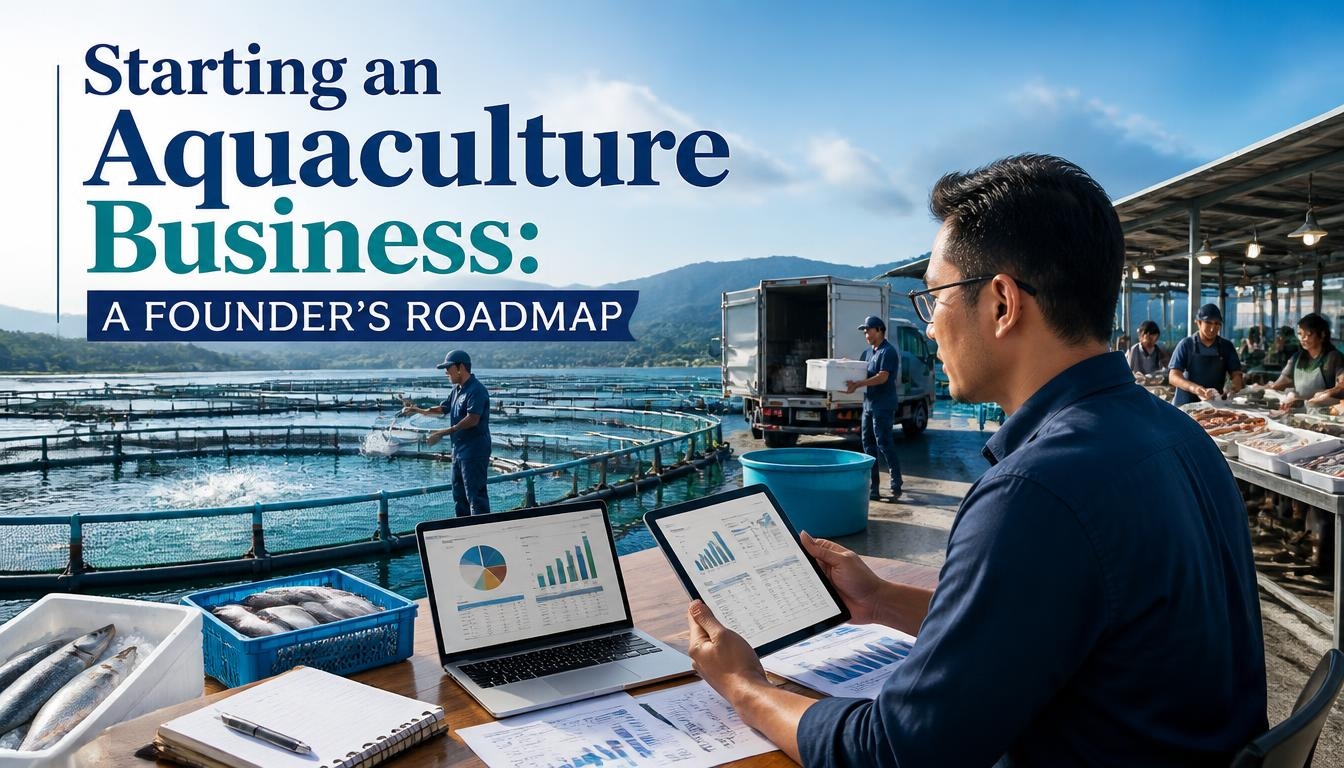
Knowing how to raise fish and knowing how to run an aquaculture business are two entirely different skill sets. Understanding feeding schedules and stocking density gets you a healthy pond of fish understanding market research, financing, and buyer relationships is what actually turns that pond into steady income. This roadmap focuses purely on the business side of launching an aquaculture farm: researching your market, planning finances, sorting out permits, funding the operation, and setting up the supply chain that decides whether a new business makes it past year one.
What It Actually Takes to Run This as a Business
There's a real gap between farming fish for the household table and operating an aquaculture farm as a registered commercial enterprise. A backyard pond can shrug off a mistake or two a business can't afford the same margin for error. Treating an aquaculture farm as a business means formal planning, proper legal registration, a real budget, and a repeatable way to get product to paying customers.
This route works best for people who already have land or water access, don't mind navigating regulatory paperwork, and have enough capital to carry the business through a full production cycle before any real income arrives. If you haven't yet nailed down the farming basics species, systems, setup that groundwork lives in our Cultivation of Fish guide; this roadmap picks up where that leaves off and focuses on the business layer built on top of it.
Step 1: Study the Market Before You Pick a Niche
Before a single pond gets dug or tank installed, figure out exactly who's going to buy what you produce. Demand shifts a lot by region some areas lean toward tilapia or catfish, others toward carp or rohu, and export buyers often want entirely different species and quality standards than local markets do.
- Map local demand walk local markets, talk to fishmongers and restaurant buyers, and note which species move fastest and at what price point.
- Size up the competition how many farms already serve your target buyers, and is there genuine room for another supplier.
- Pick your lane selling fresh locally, supplying wholesalers, or exporting each come with different volume, quality, and consistency demands.
For a business, species choice should follow market demand and pricing first not just which fish is easiest to raise, which is a separate comparison covered in our Cultivation of Fish guide.
Step 2: Put Together an Actual Business Plan
Writing even a basic plan forces the numbers into the open before any money moves, and it's usually a requirement if you're applying for financing. At a minimum, cover:
- Startup and running costs construction, fingerlings, feed, labor, utilities.
- Revenue estimates projected harvest volume, price per unit, and total revenue for each cycle.
- Break even point how many cycles it'll take to recoup the initial investment.
- Buyer targets wholesale, retail, restaurants, or export, and your plan for reaching each one.
Even a bare bones, one page version beats skipping this step entirely it's what turns a rough idea into something a lender or partner can actually evaluate.
Step 3: Sort Out Licensing and Legal Requirements
Rules here differ a lot by country and often by region within a country, so start by contacting your local fisheries or agricultural authority directly. Typical requirements include:
- Registering the business making the farm a proper legal entity.
- An aquaculture or fisheries permit usually mandatory for commercial scale fish production.
- Water use or environmental approval especially important for cage systems or farms pulling from shared water sources.
- Land use clearance particularly relevant when converting farmland or building near protected zones.
Cutting corners here tends to backfire fixing compliance issues after the fact is almost always more expensive and slower than handling it properly upfront.
Step 4: Line Up Financing and Budget Realistically
Money for a new aquaculture business generally comes from one of three places: personal savings, loans, or agricultural grants and subsidy programs, which many governments offer specifically to encourage fish farming as part of food security policy.
Costs swing widely by system type ponds are the cheapest way in, while RAS and biofloc setups demand a much bigger upfront investment in tanks, pumps, and filtration. Our Cultivation of Fish guide breaks down costs by system in more detail; from a business planning angle, the key is budgeting for feed and operating expenses across the entire first cycle, not just construction, since income won't land until after harvest.
Step 5: Build the Operational Supply Chain
Day to day operations hinge on a dependable supply chain running in both directions inputs coming in, product going out.
- Hatchery sourcing line up a trustworthy fingerling supplier well before your first stocking, and ideally have a backup source ready.
- Feed sourcing secure consistent, quality feed suppliers early, since feed is typically the largest recurring cost.
- Locking in buyers wherever possible, get buyer commitments signed before harvest rather than scrambling afterward; this is one of the clearest markers separating a hobby setup from an actual business.
None of these relationships build overnight, which is exactly why they should start well ahead of your first harvest.
Why New Aquaculture Businesses Usually Fail
A fairly predictable handful of mistakes accounts for most failed aquaculture startups, and nearly every one is preventable with proper planning:
- Running out of cash money dries up before the first harvest brings in revenue.
- No buyers secured ahead of harvest forcing rushed, low price sales or product loss.
- Skipping market research entirely building around a species nobody local actually wants.
- Lowballing feed costs the biggest ongoing expense, and the one new farmers most often underestimate.
- Growing too fast, too soon expanding before one cycle has proven out costs, yields, and buyer relationships.
FAQ
What kind of budget does launching an aquaculture business require?
It depends heavily on the system and scale chosen a small pond operation needs far less capital than a RAS or large commercial setup, and most first time owners underbudget the working capital needed to reach the first sale.
Can an aquaculture business actually turn a profit?
Yes, though real profitability usually shows up after a few production cycles, once costs, yields, and buyer relationships are dialed in, rather than immediately.
Is a license required to run an aquaculture operation?
In most places, yes business registration plus a fisheries or environmental permit are typical baseline requirements, though the specifics shift depending on country and local jurisdiction.
Which permits should an aquaculture business owner expect to need?
Expect some combination of business registration, an aquaculture or fisheries operating permit, water use or environmental approval, and possibly land use clearance, depending on local rules.
Is prior experience necessary to start this kind of business?
No, but it's wise to start on a smaller scale first, build hands on skills, and tap into local agricultural extension services or established farmers before scaling up to a full commercial operation.
What's the quickest route to lining up buyers for farmed fish?
Securing buyer commitments from wholesalers, restaurants, or processors before harvest is far more reliable than scrambling to find a market once the fish are already grown.