
Pisciculture Explained: The Science Behind Fish Farming
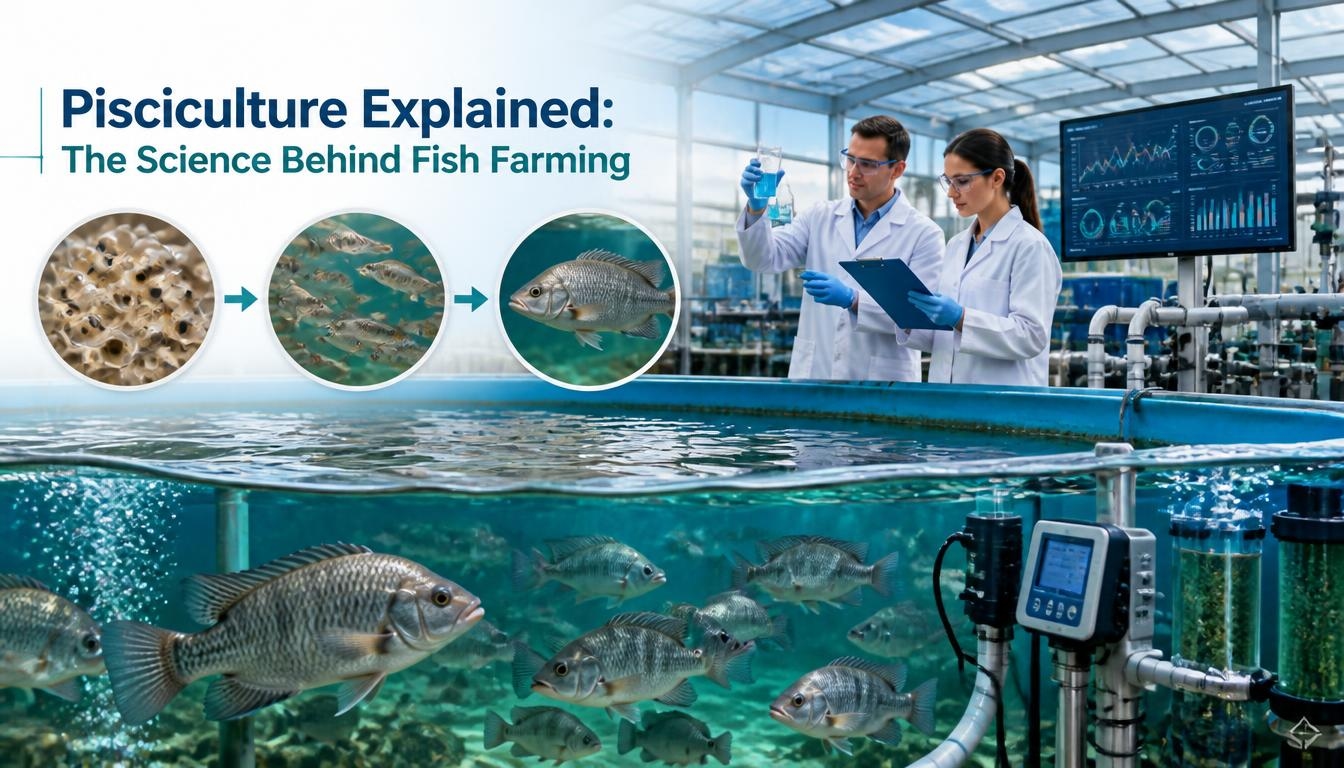
More fish now comes from farms than from the ocean. Pisciculture the scientific name for fish farming supplied 51 percent of the world's aquatic animal production back in 2022, and it crossed 100 million tonnes of output for the first time in 2024. If you've ever wondered how a fish actually gets from egg to dinner plate without a hook or a net, this guide walks through the science: the systems, the biology, and the numbers behind an industry that's reshaped how the world eats fish.
What Is Pisciculture, Exactly?
Pisciculture is the practice of breeding, raising, and harvesting fish under controlled conditions, rather than catching them from wild populations. It sits under the broader umbrella of aquaculture, which also includes farming shellfish, crustaceans, and aquatic plants but pisciculture specifically means fish. In everyday use, "pisciculture" and "fish farming" mean the same thing, and both describe an industry that now controls every stage of a fish's life: breeding, feeding, water quality, and harvest timing, none of which capture fisheries can influence.
That level of control is exactly why pisciculture has scaled so fast. Wild stocks are finite and vulnerable to overfishing; farmed production can, in principle, keep expanding as long as water, feed, and space allow.
The Science of Fish Farming: Key Systems Explained
Pond Culture
The oldest and still most widely used method globally, pond culture raises fish in earthen or lined ponds, often supplementing natural food sources with formulated feed. It's relatively low cost to set up, which is why it dominates production volume worldwide, especially for species like carp, tilapia, and catfish.
Recirculating Aquaculture Systems (RAS)
RAS represents the high tech end of pisciculture: fish are raised in closed, indoor tanks where water is continuously filtered, oxygenated, and reused rather than discharged. This dramatically cuts water consumption and gives farmers precise control over temperature and water chemistry year round, at the cost of significantly higher equipment and energy investment.
Cage & Net Pen Culture
Here, fish are raised in mesh enclosures placed directly in an existing lake, river, or coastal water body. This method avoids the need to build and fill dedicated ponds, but it also means farmed fish share the same water and any disease or waste with the surrounding wild environment, which is why site selection and stocking density are closely managed.
Raceway Culture
Raceways use a continuous flow of water moving through long, narrow channels, which naturally flushes waste and keeps oxygen levels high. This method suits coldwater species like trout and salmon particularly well, since it mimics the flowing streams these species evolved in.
Comparing the Systems
System | Water Use | Startup Cost | Best Suited For |
|---|---|---|---|
Pond culture | Moderate to high | Low | Carp, tilapia, catfish |
RAS | Very low (recycled) | High | Trout, tilapia, catfish |
Cage/net pen | Low (uses existing water) | Moderate | Salmon, trout, tilapia |
Raceway | High (constant flow) | Moderate to high | Trout, salmon |
There's no single "best" system the right choice depends on species, climate, available water, and how much capital a farm has to invest upfront.
How a Farmed Fish Actually Gets to Market
Every pisciculture operation follows roughly the same life cycle arc, regardless of which system it uses:
- Broodstock & spawning: Hatcheries maintain adult fish under controlled conditions to trigger spawning at the right time, giving farmers far more predictability than relying on natural wild spawning cycles.
- Hatchery & nursery stage: Newly hatched fry are raised in protected, closely monitored tanks or ponds where survival rates are far higher than they would be in open water, since predators and competition are removed.
- Grow out stage: Once large enough, fish move into ponds, cages, raceways, or RAS tanks for the bulk of their growth period, where feed conversion and water quality management drive most of the operation's day to day work.
- Harvest & processing: Fish are harvested once they reach target market size, then processed and moved into the supply chain a timeline a farm can plan around, unlike a wild catch that depends entirely on what the ocean provides that day.
This level of predictability knowing roughly how many fish you'll have and when is the core economic advantage pisciculture holds over capture fisheries, and it's the main reason the industry has scaled so dramatically.
Global Fish Farming by the Numbers
The scale of this shift is striking. Aquaculture made up only about 4 to 5 percent of total aquatic animal production in the 1950s. By the 2010s, that share had climbed to roughly 44 percent, and in 2022, farmed fish officially overtook wild caught fish for the first time in history, supplying 51 percent of global aquatic animal production. Global aquaculture crossed 100 million tonnes of output for the first time in 2024, and 2025 forecasts put aquaculture production at roughly 104 million tonnes, compared with about 93 million tonnes from capture fisheries meaning farmed fish now outproduces wild caught fish by a growing margin each year.
Asia accounts for the overwhelming majority of this production, with China as the single largest producer by far. That regional concentration reflects decades of infrastructure buildout, favorable growing conditions, and enormous domestic demand the same forces that have made carp, salmon, catfish, and shrimp the dominant farmed species worldwide, alongside tilapia, whose growth has recently plateaued even as other species keep climbing.
Sustainability Challenges & Solutions
Pisciculture's growth has brought real environmental trade offs alongside the food security gains, and much of the industry's current research effort is aimed squarely at managing them.
Water use and scarcity is one of the biggest constraints, particularly for pond based systems in water stressed regions. RAS technology directly addresses this by recycling water rather than continuously drawing fresh supply, though its higher energy use is its own trade off.
Disease risk tends to rise with stocking density, since fish held close together in shared water can spread pathogens faster than dispersed wild populations would. Better biosecurity protocols, selective breeding for disease resistance, and species diversification all help reduce this risk.
Nutrient and waste output is being addressed through approaches like Integrated Multi Trophic Aquaculture (IMTA), which pairs fin fish with filter feeding species or aquatic plants so that one species' waste output becomes another's food or nutrient source, cutting the operation's overall environmental footprint rather than simply discharging waste into the surrounding water.
Feed remains a persistent cost and sustainability pressure across the industry too formulated feeds need to balance protein, fat, and micronutrient needs for each species and life stage, and ongoing research into alternative feed ingredients aims to reduce reliance on wild caught fish meal, which would otherwise undercut some of aquaculture's own sustainability gains.
FAQ
What does pisciculture mean?
Pisciculture is the practice of breeding, raising, and harvesting fish under controlled conditions it's simply another word for fish farming.
Is fish farming the same as aquaculture?
Aquaculture is the broader category, covering farmed fish, shellfish, crustaceans, and aquatic plants. Pisciculture is the specific term for farming fish.
What percentage of the world's fish supply now comes from farming?
Farmed fish supplied 51 percent of global aquatic animal production in 2022, the first year aquaculture outproduced capture fisheries, and that share has kept growing since.
What's the most common fish farming system in the world?
Pond culture, largely because it's the least capital intensive system to build and operate, especially for species like carp, tilapia, and catfish.
What is RAS in fish farming?
RAS stands for Recirculating Aquaculture System a closed indoor system that filters and reuses the same water rather than discharging it, dramatically cutting water use compared with pond or raceway systems.
Why has fish farming grown so much faster than wild fishing?
Because pisciculture gives farmers control over breeding, feeding, and harvest timing, while capture fisheries depend on finite wild stocks that are vulnerable to overfishing and can't simply be scaled up on demand.
What are the biggest environmental concerns with fish farming?
Water use, disease spread at high stocking densities, and nutrient/waste output are the main challenges, with technologies like RAS and IMTA (Integrated Multi Trophic Aquaculture) specifically designed to address them.
Conclusion
Pisciculture has gone from a marginal food source to the primary way the world produces fish, and the shift comes down to control over breeding, feeding, water quality, and timing that wild capture fisheries simply can't offer. As the industry keeps growing past the 100 million tonne mark, the next chapter is less about raw scale and more about which systems and practices can keep that growth sustainable. For more on how specific farmed species are raised, browse our Fishing & Seafood Industry section.