
Pacific Whiting Explained: Habitat, Harvest & Uses
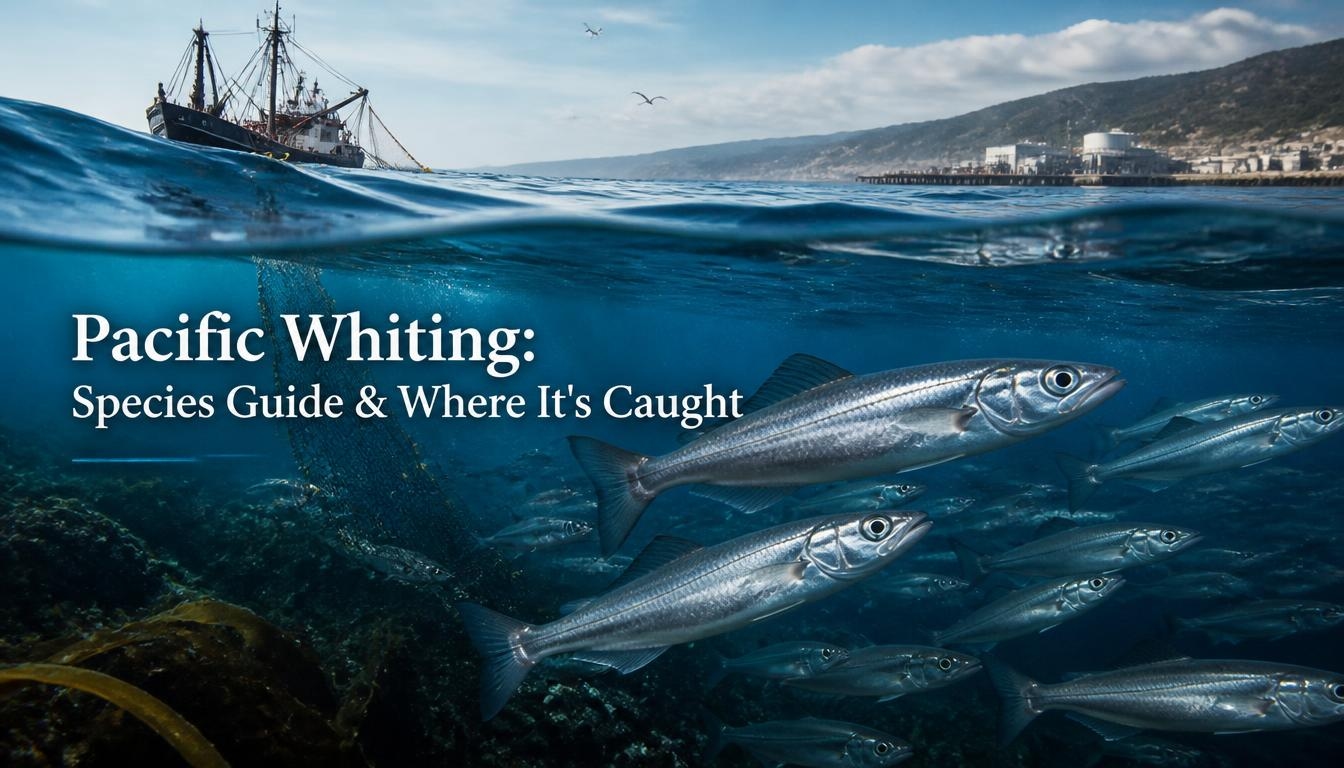
Chances are you've eaten Pacific whiting without ever hearing the name it's the single most heavily caught groundfish along the entire West Coast, quietly powering a surimi and fillet industry most people never think about. This species profile builds on our West Coast Fishing pillar here's what Pacific whiting is, where it's found, how it ends up on a boat, what happens to it afterward, and how well its fishery is actually managed.
Getting to Know Pacific Whiting
Pacific whiting (Merluccius productus) better known to most as Pacific hake is a slim, silvery groundfish that ranges along the West Coast of North America. It's part of the hake family, cod like fish recognizable by an elongated body, oversized eyes, and a jutting lower jaw lined with sharp teeth. Most adults run 20 to 24 inches, with occasional larger catches.
This is a schooling fish, typically found in dense aggregations that make it a natural fit for commercial trawling. It also grows fast and doesn't live especially long compared to other groundfish, reaching maturity within just a few years a trait that shapes how the fishery around it is managed.
Where Pacific Whiting Lives
Pacific whiting's range stretches from northern Baja California all the way up to British Columbia, though the population most heavily fished commercially sits off California, Oregon, Washington, and southern Canada. The species makes a distinct seasonal journey: spawning happens off Southern California and Baja in winter, followed by a northward migration through spring and summer toward the richer feeding grounds off Oregon, Washington, and Vancouver Island.
Whiting is semi pelagic, shifting between mid water and near bottom depths depending on the time of day and season, generally somewhere between 300 and over 3,000 feet down. Because this single population crosses back and forth between US and Canadian waters throughout the year, its fishery is managed jointly by both countries rather than separately.
How Pacific Whiting Gets Caught
By volume, Pacific whiting is the biggest groundfish fishery on the West Coast, harvested almost entirely through midwater trawling large nets towed through the water to sweep up the dense schools the species forms. The fishery runs through a few distinct sectors: shoreside trawlers that bring their catch to land based processors, and at sea processing vessels that handle catching and processing in a single trip.
Recreational anglers rarely target Pacific whiting, and any they do catch tends to be incidental rather than intentional. This is almost entirely a commercial fishery, and the numbers back that up whiting's catch volume often outpaces every other West Coast groundfish species combined in a given season.
What Happens to Pacific Whiting After It's Caught
Most of the Pacific whiting catch is turned into surimi the processed, minced product behind imitation crab and similar seafood substitutes making it one of North America's key surimi source species. What isn't turned into surimi gets processed into fillets, fish meal, or fish oil.
A defining trait of Pacific whiting is how quickly it needs processing after being caught. It carries a natural parasite whose enzyme breaks down the flesh rapidly after death, which is why so much of the catch is handled at sea or processed the same day onshore rather than sold fresh and whole. This time pressure has shaped the entire fishery around speed the boats and plants involved are built specifically to move fast.
How Sustainable Is the Pacific Whiting Fishery?
The US and Canada manage Pacific whiting together under a bilateral agreement, given that the same stock crosses both countries' waters each year. Regular joint stock assessments feed directly into catch limits set for the shared population a more coordinated approach than many fisheries operating under a single country's rules alone.
Set next to Northern cod, a stock that collapsed after decades of poorly coordinated, under monitored fishing, Pacific whiting's management looks considerably more proactive: frequent joint assessments, catch limits pegged to real time population data, and a fast growing, short lived biology that makes the species naturally more resilient to fishing pressure than slower growing fish. Even so, like any actively harvested stock, whiting's numbers still shift year to year with ocean conditions, and catch limits move accordingly. For a deeper look at how these assessments and limits actually get set, our Fisheries Science guide covers that process.
FAQ
What's another name for Pacific whiting?
It's more commonly called Pacific hake both names describe the same species, Merluccius productus.
Are Pacific whiting and hake actually the same fish?
Yes, they're the same species though "hake" is also a broader term covering related fish found in other parts of the world.
Which waters is Pacific whiting fished from?
Mainly off California, Oregon, Washington, and southern British Columbia, tracking the species' seasonal move between southern spawning grounds and northern feeding areas.
Does Pacific whiting taste good?
It can, though its flesh breaks down quickly after being caught, which is why most of it goes into surimi, fillets, or fish meal shortly after harvest instead of being sold whole and fresh.
Is the Pacific whiting fishery considered sustainable?
It's managed jointly by the US and Canada with regular stock assessments and catch limits based on current data, putting it among the better managed groundfish fisheries around.