Salmon Life Cycle: All 7 Stages Explained
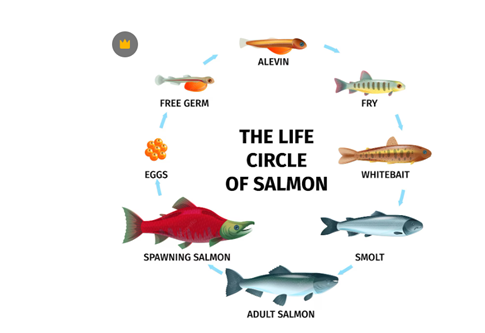
The salmon life cycle has seven main stages: egg, alevin, fry, parr, smolt, adult, and spawning adult. But a salmon does much more than simply grow larger from one stage to the next.
Most salmon are anadromous fish, meaning they begin life in freshwater, migrate to saltwater to feed and grow, and later return to freshwater to reproduce.
Along the way, their appearance, behavior, habitat, and even the way their bodies regulate salt and water change.
The exact timing is not the same for every species. Some young salmon leave freshwater quickly, while others remain there for years. Some adults spend only a short period at sea, while others remain in the ocean for several years before returning.
Here is how the journey unfolds.
Salmon Life Cycle at a Glance
| Stage | What Happens | Main Habitat |
| Egg | Embryo develops inside a protected egg | Freshwater gravel |
| Alevin | Newly hatched salmon lives on its yolk sac | Beneath freshwater gravel |
| Fry | Young salmon emerges and begins feeding | Freshwater |
| Parr | Juvenile feeds, grows, and develops | Freshwater |
| Smolt | Body adapts for migration into saltwater | River and estuary |
| Adult | Salmon feeds, grows, and reaches maturity | Ocean |
| Spawning adult | Mature salmon returns to reproduce | Freshwater |
This pattern describes the general salmon life cycle, but the length of each stage can differ considerably among species and populations.
Stage 1: Egg – Life Begins Beneath the Gravel
A salmon’s life begins in freshwater.
A mature female chooses an area of suitable gravel and creates a nest known as a redd. She releases her eggs into the redd, where a male fertilizes them. The female then moves gravel over the eggs, helping protect the developing embryos.
Salmon eggs need more than gravel for protection. Water must be able to flow between the stones and carry oxygen to the embryos.
Sediment, unsuitable temperatures, poor water quality, and major changes in stream conditions can reduce the quality of spawning habitat.
Depending on species and environmental conditions, salmon can remain inside their eggs for weeks or months before hatching.
The fish is developing, but its journey has not yet taken it beyond the gravel.
Stage 2: Alevin – Living on the Yolk Sac
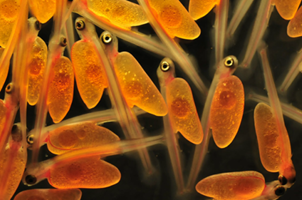
Once the egg hatches, the young salmon enters the alevin stage.
An alevin looks like a tiny fish with a relatively large yolk sac attached to its underside. Instead of immediately swimming away to search for food, it remains protected within or close to the gravel.
The yolk sac contains the nutrients the young salmon needs during this early period.
As the alevin grows, the yolk sac gradually becomes smaller.
Once those stored nutrients have been absorbed, the fish must leave the protection of the gravel and begin feeding independently.
It is now entering the fry stage.
Stage 3: Fry – Feeding Independently for the First Time
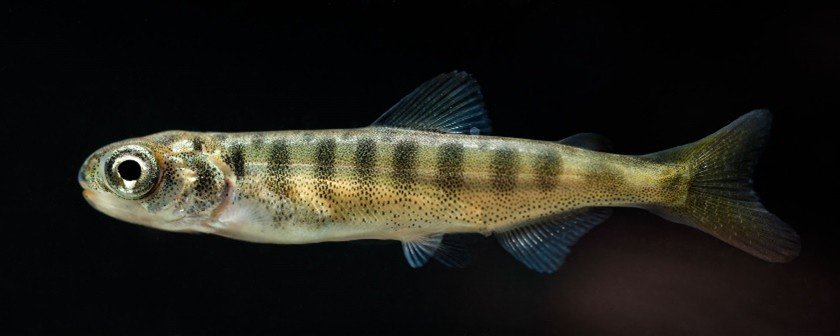
A fry is a young salmon that has emerged from the gravel and started feeding for itself.
Life suddenly becomes much more demanding.
The fry must find food while avoiding predators and coping with water currents. Suitable shelter can also become important, including areas around rocks, vegetation, woody material, pools, and other stream structures.
This transition matters because the salmon is no longer surviving on nutrients stored in its yolk sac.
It has become an independent feeder.
Not every salmon species remains in freshwater for the same amount of time after reaching this stage. Pink salmon fry, for example, usually migrate toward estuarine and marine waters soon after emerging. Other species may remain in freshwater considerably longer.
That is why the salmon life cycle should be viewed as a general biological pattern rather than a fixed timetable.
Stage 4: Parr – Growing in Freshwater
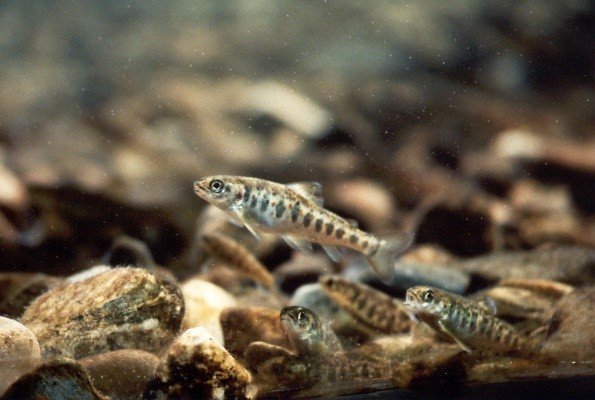
As many juvenile salmon continue growing in freshwater, they enter the parr stage.
Parr often have dark vertical markings along their sides known as parr marks. Their appearance is quite different from the silvery coloration associated with salmon preparing to enter the ocean.
This is an important growth period.
Juvenile salmon feed, seek shelter, avoid predators, and develop the body condition needed for future migration.
How long this stage lasts depends heavily on the species and population.
Coho salmon commonly spend about a year in streams and rivers before migrating toward the ocean. Sockeye fry may spend approximately 1–3 years in freshwater before becoming smolts, particularly in life histories associated with lake systems. Atlantic salmon parr may remain in freshwater for around 2–3 years before smoltification.
For other salmon, the freshwater juvenile period can be much shorter.
There is no single schedule that applies to every salmon.
Stage 5: Smolt – Adapting to Saltwater
One of the most dramatic changes in the salmon life cycle happens when a freshwater juvenile becomes a smolt.
A smolt is not simply a larger parr.
Its body is preparing for an entirely different environment.
Freshwater and seawater create very different challenges for maintaining the correct balance of water and salts inside a fish’s body. During smoltification, physiological changes develop that allow the juvenile salmon to function in saltwater.
Osmoregulation is a key part of this transition. The salmon’s ion-regulating systems must change so the fish can maintain its internal salt and water balance after entering the marine environment. Research on salmon smoltification shows that the development of these osmoregulatory systems is critical to successful seawater entry.
Visible changes happen too.
Parr markings may become less obvious, and the fish develops a more silvery appearance.
Behavior also changes as the smolt begins moving downstream.
It passes from freshwater habitat through rivers and often estuaries before reaching the sea.
For a fish that began life hidden beneath river gravel, entering the ocean is one of the largest environmental transitions it will ever experience.
Stage 6: Adult Salmon – Feeding and Growing in the Ocean
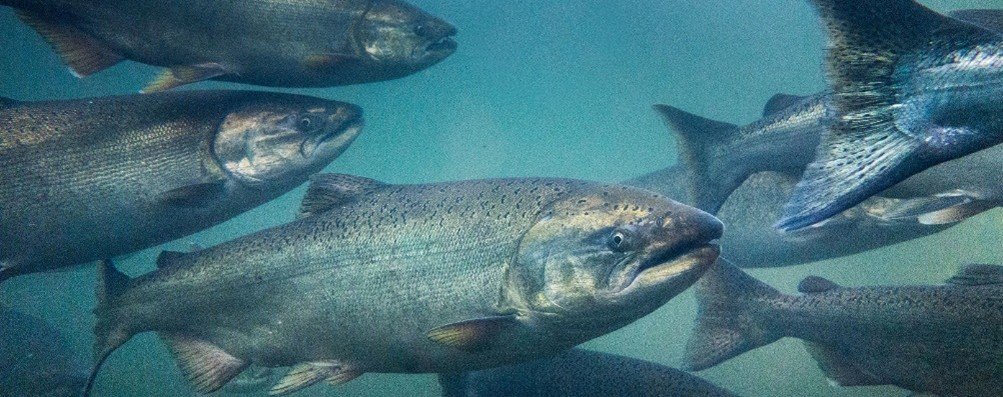
For many salmon, the ocean becomes the main feeding and growth phase of adult life.
Marine environments provide opportunities to feed, grow rapidly, and accumulate the energy reserves needed for reproduction.
But again, the amount of time spent at sea differs by species.
Coho salmon generally spend around 1½ years feeding in the ocean before returning to freshwater. Chinook salmon may spend several years at sea and can mature anywhere from roughly 2–7 years of age, although many return at age three or four.
Pink salmon follow a much shorter and more predictable schedule.
They usually spend about 1½ years feeding in the ocean and complete their entire life cycle at approximately two years of age.
During the marine phase, the salmon is preparing for the final major journey of its life.
Eventually, reproductive maturation begins and the fish turns back toward freshwater.
Why Do Salmon Return to Freshwater?
Adult salmon return to freshwater primarily to reproduce.
Many return to the same river system, and often toward the natal habitat associated with where they began life. NOAA describes Pacific salmon as generally returning as adults to the streams where they were born to spawn.
The migration may involve moving from the ocean through estuaries and rivers before reaching suitable spawning habitat.
For some populations, that journey can be remarkably demanding.
Salmon may need to swim against strong currents, travel long distances, pass obstacles, and rely heavily on stored energy during the migration.
Freshwater is therefore not simply somewhere salmon return because they prefer it.
It provides the spawning and early-development habitat required to begin the next generation.
How Do Salmon Find Their Way Back?
One of the most fascinating parts of salmon migration is their ability to return toward the waters associated with their birth.
Scientists have studied this behavior extensively, but the complete navigation system is complex.
Chemical and scent cues are thought to play an important role in helping salmon identify their natal streams, while other environmental and navigational cues may contribute during the broader migration. The National Park Service notes that scents, chemical cues, and the sun are among the factors believed to be involved in salmon homing.
This ability is often referred to as homing.
It connects the salmon’s adult migration directly to the freshwater environment where its own life began.
Stage 7: Spawning Adult – Beginning the Next Generation
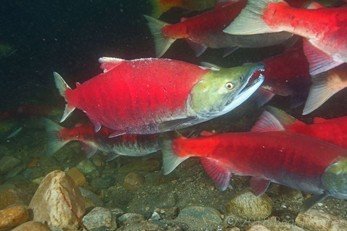
Once mature salmon reach suitable spawning habitat, reproduction begins.
The female prepares a redd in the gravel and deposits her eggs. A male releases sperm to fertilize them, and the eggs are then protected beneath gravel.
The life cycle has come full circle.
But what happens to the adults afterward depends on the type of salmon.
Pacific salmon such as Chinook, coho, sockeye, pink, and chum are semelparous: they reproduce once and die after spawning. NOAA confirms this pattern for major Pacific salmon species such as Chinook, sockeye, and pink salmon.
Atlantic salmon follow a different reproductive strategy.
Atlantic salmon do not necessarily die after spawning. Some survive, return toward the ocean as “kelts,” recover, and may later migrate back to reproduce again. This repeat-spawning strategy is known as iteroparity.
This distinction is important.
There is no single reproductive outcome that applies to every fish commonly called salmon.
How Long Does the Salmon Life Cycle Take?
There is no universal number because life-cycle length varies among species and populations.
A better way to answer the question is to look at examples.
| Salmon | Approximate Life-Cycle Pattern |
| Pink salmon | Typically completes its life cycle in 2 years |
| Coho salmon | Commonly around 3 years |
| Sockeye salmon | Often around 4–5 years, although timing varies |
| Chinook salmon | Can mature between about 2–7 years |
| Atlantic salmon | Timing varies; some adults can survive and spawn again |
Pink salmon provide one of the clearest examples. They have a highly regular two-year life cycle.
Coho commonly have a roughly three-year pattern, while sockeye often mature around four or five years depending on the population.
Chinook show even greater variation. NOAA reports that they can sexually mature between two and seven years of age, although three or four years is common.
So the answer to “How long does a salmon live?” depends first on which salmon you mean.
How the Salmon Life Cycle Differs by Species
The basic freshwater-to-ocean-to-freshwater pattern is useful, but salmon species do not follow it in exactly the same way.
Pink Salmon
Pink salmon have one of the shortest and most predictable life cycles.
Young fish move toward estuarine and marine waters soon after emerging, spend roughly 1½ years feeding in the ocean, and generally return to spawn at two years old.
Coho Salmon
Coho typically spend a significant juvenile period in freshwater.
NOAA reports that they commonly spend around a year in streams and rivers followed by approximately 1½ years feeding and growing in the ocean before returning to spawn.
Sockeye Salmon
Sockeye often have a strong connection with freshwater lakes.
In many systems, juveniles spend roughly 1–3 years in freshwater before smolting and moving to the ocean. Adults commonly mature at around four or five years, although variation occurs.
Chinook Salmon
Chinook have especially variable life histories.
Some populations spend much longer in the ocean than others. Adults may mature between two and seven years of age before returning to freshwater to spawn.
Atlantic Salmon
Atlantic salmon also migrate between freshwater and marine environments, but their reproductive story differs from Pacific salmon.
Some adults survive their first spawning migration and may return to reproduce again.
These differences explain why giving a single age, migration schedule, or freshwater residence time for “salmon” can be misleading.
What Can Disrupt a Salmon’s Journey?
A salmon depends on several connected habitats during its life.
That means problems at one stage can affect survival much later.
| Life Stage | Examples of Potential Challenges |
| Egg and alevin | Sediment, poor water quality, unsuitable temperature, low-quality spawning habitat |
| Fry and parr | Habitat loss, temperature stress, limited food, predation |
| Smolt | Migration barriers, dams, poor river conditions, difficult estuary passage |
| Ocean adult | Changing marine conditions and food availability |
| Returning adult | Migration barriers, altered river flows, unsuitable spawning habitat |
Migratory fish depend on physiological systems involved in ion regulation, growth, energy use, stress, and reproduction. Environmental conditions including temperature, salinity, dams, and pollution can interfere with normal development and migration.
This is why protecting only the spawning ground is not always enough.
The salmon’s freshwater habitat, migration route, estuary, and marine environment are all connected parts of the same life cycle.
Why Every Stage Matters
Each stage prepares the salmon for what comes next.
Egg: The embryo needs protected, oxygenated freshwater habitat.
Alevin: The young salmon develops beneath the gravel while depending on nutrients stored in its yolk sac.
Fry: It begins feeding independently and avoiding predators.
Parr: The juvenile grows and develops in freshwater.
Smolt: Physiological changes prepare it for saltwater.
Adult: Marine feeding supports growth and reproductive maturation.
Spawning adult: The fish returns to freshwater and produces the next generation.
Remove one important connection between these stages and the effects can be felt throughout the life cycle.
FAQs
What are the seven stages of the salmon life cycle?
The commonly described stages are egg, alevin, fry, parr, smolt, adult, and spawning adult. The exact length and importance of each stage varies among salmon species.
What is the difference between fry, parr, and smolt?
A fry is a young salmon that has emerged from the gravel and begun feeding independently. A parr is a growing freshwater juvenile, often recognizable by vertical parr markings. A smolt is a juvenile undergoing physiological changes that prepare it for saltwater.
What is smoltification?
Smoltification is the biological transformation that prepares a juvenile salmon for migration from freshwater into the marine environment. It includes changes associated with salt and water regulation, appearance, physiology, and migratory behavior.
How long do salmon stay in freshwater?
It depends on the species. Pink salmon may move toward the sea soon after emerging, while sockeye can spend 1–3 years in freshwater and Atlantic salmon parr may remain there for approximately 2–3 years before becoming smolts.
Do salmon return to the river where they were born?
Many salmon show strong natal homing and return toward the freshwater systems associated with where they were born. Chemical and scent cues are thought to contribute to their ability to identify natal waters.
Why do salmon swim upstream?
Mature salmon swim upstream to reach suitable freshwater spawning habitat where eggs can be deposited and the next generation can begin developing.
Do all salmon die after spawning?
No.
Pacific salmon species such as Chinook, coho, sockeye, pink, and chum die after spawning. Atlantic salmon are different because some survive spawning and may reproduce again later.
How long does a salmon live?
There is no single lifespan for all salmon. Pink salmon usually complete their life cycle in two years, coho commonly live around three years, sockeye often live around four or five years, and Chinook may mature anywhere between roughly two and seven years.
The Salmon Life Cycle Is a Journey Between Two Worlds
A salmon’s famous upstream migration is only one part of its story.
The journey begins much earlier, with an egg protected beneath freshwater gravel.
The fish hatches as an alevin, emerges as a fry, grows through its juvenile stages, and prepares for saltwater through smoltification. It then enters the marine environment, where many salmon spend an important period feeding and growing.
Eventually, a mature salmon turns back toward freshwater.
There, spawning connects one generation with the next.
What makes the salmon life cycle remarkable is not simply that the fish grows. It changes its habitat, physiology, appearance, and behavior throughout its life.
And although salmon species share the same broad journey, there is no single timetable that defines them all.
That variation is what makes understanding the salmon life cycle both more accurate and more interesting.